How do you actually start after 40?
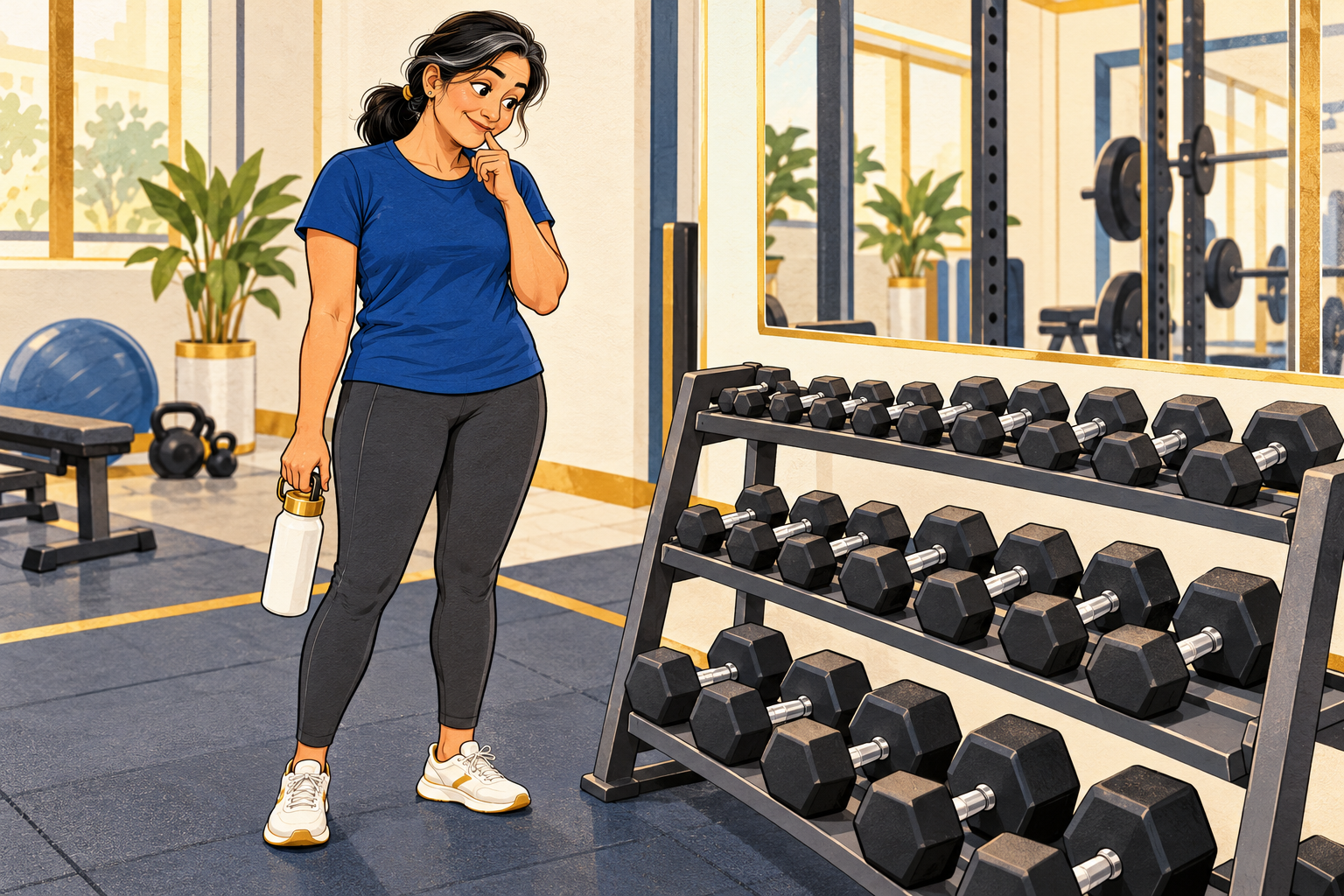
An imagined first visit: you’re 43, studying the dumbbell rack like a restaurant menu. Plenty of numbers. No “beginner’s special”. The person beside you has already chosen.
Start by learning a movement version you can control, choose resistance suited to your ability, then build the challenge gradually. Your current experience and health matter more than copying someone else’s weight.
Two choices—not one magic starting weight
- CHOOSE THE VERSION
What movement can I learn?
A wall push-up and a floor push-up ask different things of you—even with no dumbbell.
- THEN FIND THE EFFORT
How challenging should it be?
Adjust resistance and repetitions to present ability; learn control, then build challenge.
First, choose the movement. Then choose the weight.
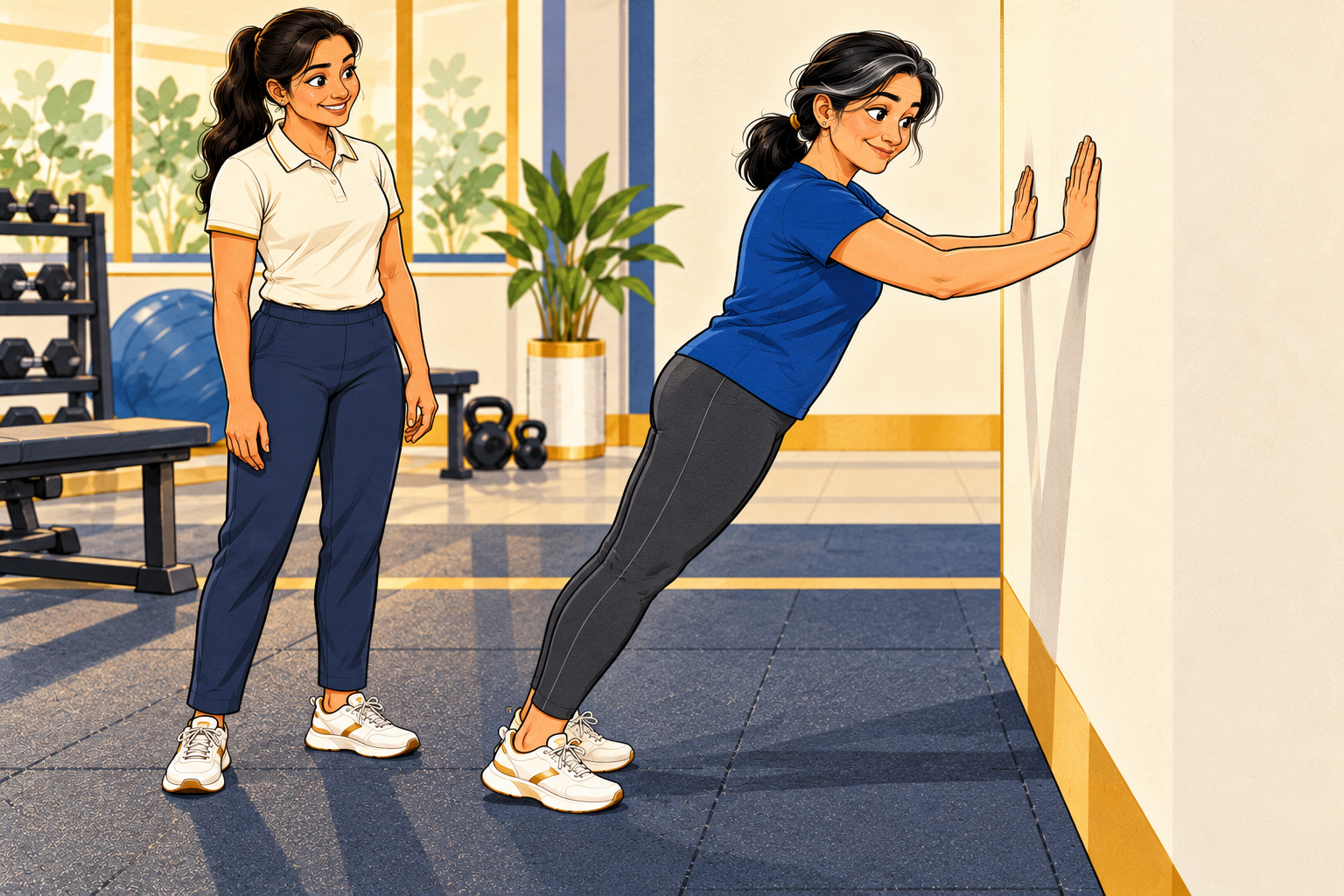
Back to our imagined beginner. She last trained regularly in her thirties. Her old workout notes say “push-ups”; today, a floor push-up feels beyond her control. The notes remember the exercise. They cannot choose today’s starting version.
A wall push-up is one option to explore with guidance. Changing the exercise version and changing the weight are different decisions. Body weight is not automatically easy; equipment is not automatically advanced.
For this 43-year-old returner, the long gap makes her old routine a reference, not a target to copy on day one. A first-time beginner has no old routine to compare with; the same starting question is useful: what can I learn and control now?
From a starting version to a clear next visit

“Manageable” should not mean “effortless forever”
A practice set is for learning. As the movement becomes familiar, the work should also challenge your muscles.
The 2026 ACSM position stand describes leaving roughly two or three possible repetitions at the end of a set as one way to achieve sufficient effort. In plain English: you could do a few more, but you stop before the next repetition becomes impossible. Treat this as an effort cue, not an exact beginner measurement or a reason to ignore pain.
Our beginner’s next question is better than “Does this dumbbell look impressive?” It is: “Can I keep control, and is the work challenging enough?”
Evidence: [1]
Friday’s choice: repeat the version, not the old routine
Here is an illustrative week for a generally healthy beginner: strength on Tuesday and Friday, with recovery days between. Adult guidance includes strengthening work on at least two days a week, covering the major muscle groups. Walking and other aerobic activity still matter.
After a warm-up, get guidance on suitable movements. A squat variation, a push and a row are examples—not a complete programme. Agree the setup, breathing, resistance, repetitions and rest for your starting point.
On Friday in our imagined example, she still needs reminders about the wall-push-up setup. The choice is to repeat that version with guidance, rather than move to the floor because it is session two. The reason: she is still learning the movement.
If a version remains difficult to control despite guidance, it may need adjusting. If the agreed work becomes controlled and comfortably repeatable, review whether to increase the challenge. The next step follows what happens in the set, not the date on the calendar.
Your first visits: learn → revisit → review
- FIRST VISIT
Leave with a starting choice
Know the movement version, setup, resistance and reps agreed for you.
- NEXT VISIT
Still learning? Repeat or adjust
In our example, setup reminders are still needed. Repeat the wall version with guidance; session two does not require a harder exercise.
- WHEN READY
Let the review guide progression
When the agreed work is controlled and comfortably repeatable, review a gradual increase in challenge.
When should the plan change?
A useful starting level can change. Progression means gradually increasing the challenge as your ability develops; that can involve resistance, repetitions or other programme adjustments. One hard session is not a deadline to move up the rack.
Health changes matter too. If you have a chronic condition or a relevant injury, get advice suited to it before deciding your plan. Stop exercising and seek prompt medical help for chest pain, faintness or unusual severe breathlessness. Pain is not a signal to prove you can finish the set.
You don’t need the neighbouring dumbbell
Return to that rack. It still has the same numbers. Her old workout notes can stay in the bag; today she knows why she is repeating the wall version and what the next review is for.
That is a useful first step after a long gap: leave with a reason for your exercise choice, rather than a contest with the routine you remember.
At IMFIT Madhapur, Angadh includes trainer guidance with strength, conditioning and movement adapted to your level. You can join to get stronger without a weight-loss goal. Individual functional training and fully personalised one-to-one PT are different services.
Bring this question: “I’m starting after 40. How will we choose my movements and decide when to progress?”
Evidence: [5]
Questions people ask
What weight should a beginner over 40 lift?
There is no universal kilogram number. It depends on the exercise, your experience and your ability to perform it with appropriate technique. A useful weight for a row may be unsuitable for another movement. Ask for help selecting and reviewing the resistance rather than testing your maximum to find a first weight.
Is the starting approach different for women over 40?
Women can benefit from resistance training too. The starting decisions still depend on experience, ability, goals and health—not a single women’s starting weight. Pregnancy, a relevant diagnosis or symptoms can call for specific professional advice; this general guide does not cover those individual needs.
Can I start with body weight instead of dumbbells?
Yes. Body-weight exercises, bands, machines and free weights are all possible resistance-training tools. Body weight does not automatically mean easier: a wall push-up and a floor push-up differ in difficulty. Choose a suitable version and progress it as you learn.
Build your next step
Sources and further reading
- ACSM Position Stand (2026): resistance training prescription in healthy adults; checked 17 October 2026
- AHA Scientific Statement (2023 update, published 2024): resistance training progression and safety; checked 17 October 2026
- CDC: What counts as physical activity for adults; checked 17 October 2026
- CDC: Adding physical activity as an adult, including when to consult your doctor; checked 17 October 2026
- IMFIT: Angadh functional training, current service details; checked 17 October 2026
Sources checked 2026-10-17.
This article is for general information and does not replace professional medical advice. Consult a qualified healthcare professional for guidance suited to your needs.
Find a starting level you understand
Explore Angadh’s trainer-guided strength and functional training, then ask how the exercise choices and progression would fit your starting point.
Explore Angadh training