When grip ends the set
Imagined scene in Madhapur. Neha puts the deadlift bar down after five reps as her fingers start to open. A friend offers straps.
If your grip slips during an otherwise steady set, straps can help you practise the pull. To practise your grip, choose a load you can hold without straps.
Give the set one job
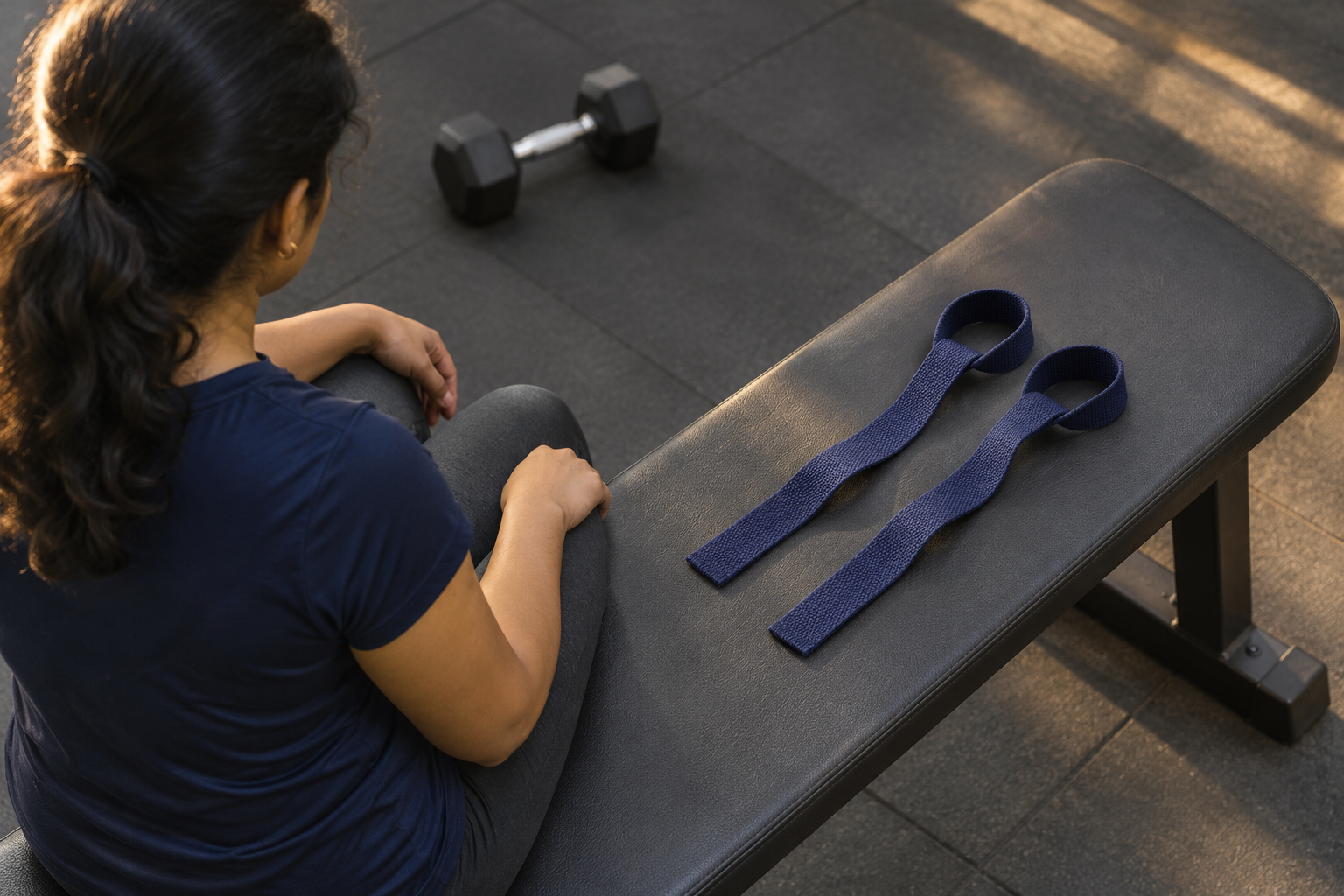
A lifting strap loops around your wrist and wraps around the bar. It helps keep your hand connected to the bar, which changes the demand on your grip. You still have to lift and lower the weight with control.
Before Neha reaches for the straps, she can name what happened. Did the bar start slipping while the pull still felt steady? Did the movement itself become hard to control? The first is a reason to look at grip. The second is a reason to end the set and review the load or setup. What she felt is a clue she can discuss with a trainer.
The same bar can give you two different jobs
What do I want to practise?
- Grip practice
Holding the bar
An unstrapped set gives you practice keeping your hold through the lift and the controlled lowering.
- Pulling practice
Practising the pull
A strap helps you keep hold of the bar so you can focus on practising the pull.
What the studies actually measured
In a small study of 10 women with resistance training experience, participants completed more deadlift reps with straps at the same weight and had a smaller immediate drop in measured grip strength. They were doing sets for as many reps as they could. That setup helps explain why grip can matter when you have to keep holding on.
Another study of 16 trained men used four sets of four reps. At the same weight, straps did not make a clear difference to how well bar speed was maintained within those sets. Both studies looked at what happened within a session. They tell us more about holding and pulling on the day than about who will get stronger over months.
Change one thing and write it down
Say Neha planned six reps at 25 kg and set the bar down after five because her fingers were opening. Her phone note could read “25 kg, 5 controlled reps, grip started slipping, no straps.” The weight and rep count are illustrative.
If the next visit is about holding the bar, she could use a lighter load she can grip through the planned set, say 20 kg in this example. If the visit is about practising the pull and her trainer agrees the setup is suitable, she could try straps at the same 25 kg and keep the planned rep count. She can record what ended that set, too. Raising the weight on the same day would make it harder to tell what changed.
Choose the next set from what you observed
Grip slipped and you want to practise holding
Go lighterKeep the set unstrapped. Note the load and how many reps you held with control.
Grip slipped and you want to practise pulling
Ask about strapsAsk a trainer to show you the setup. Keep the load comparable and note any slipping.
Control went before your grip did
Review the setupEnd the set. Review the setup or load with a trainer before trying again.
Keep the comparison simple
Use the same deadlift variation and equipment when you compare the two attempts. Stop at the reps you planned, or earlier if your grip or control goes. If both sets end as planned, the useful difference may be that one felt easier to hold. Mark that in the log instead of trying to squeeze out another rep.
You can keep some manageable work unstrapped if grip is a priority. The split can follow the job of each set, and you can revisit it when your programme changes.
Bring the stopping point to a trainer
Back at the bench, Neha has a more useful question than “Should I buy straps?” She can show the note and ask a trainer to watch where she loses her hold or control. Then she can choose whether to adjust the setup, practise a lighter unstrapped set or learn how to use straps for a pulling set.
Evidence: [3]
Questions people ask
Are lifting straps and wrist wraps the same thing?
They do different jobs. Lifting straps wrap around the bar and help you hold it. Wrist wraps fit around the wrist for support and stay off the bar.
Do I need straps at a particular weight?
There is no single kilogram threshold. Start from the job of the set and what you observe at a load you can control. The weights used in the studies were set relative to each lifter's ability.
Build your next step
Sources and further reading
- Trahey et al. Deadlift repetitions and grip fatigue with lifting straps (2023, checked 9 November 2026)
- Jukic, García-Ramos and Tufano. Deadlift bar-speed measures with lifting straps (2023, checked 9 November 2026)
- ACSM. Resistance training guidance for healthy adults (2026, checked 9 November 2026)
- IMFIT. Current Angadh programme and coaching options (checked 9 November 2026)
- IMFIT. Membership coaching and dedicated personal training (checked 9 November 2026)
Sources checked 2026-11-09.
This article is for general information and does not replace professional medical advice. Consult a qualified healthcare professional for guidance suited to your needs.
Get a second pair of eyes on your deadlift
In Madhapur, Angadh includes trainer guidance on a shared training floor. Ask a trainer to watch your setup and see where the set starts to change. IMFIT offers dedicated personal training separately.
Explore Angadh coachingWas this useful?
A little feedback helps us choose what to explain next.
Your questions & thoughts
What would help you put this into practice?
Comments appear after review. Keep it kind and relevant; please leave out phone numbers, medical details and other private information.
Loading reader comments…
Leave a comment +