The useful number comes after the movement
Start with a load you can move through the intended repetitions with steady control and suitable effort. Learn the setup first, begin light and adjust from what you can actually do. There is no single starting kilogram value for all beginners, ages or exercises.
In this imagined scene, a newcomer asks a friend what weight to use. The friend replies, “I started with ten.” Ten what, on which machine, doing which exercise? The answer has arrived without the question it belongs to.
Choose the exercise before choosing the number
A machine row, a dumbbell press and a supported sit-to-stand are different tasks. Even two machines with the same exercise name can feel different. First learn the controls, appropriate position and comfortable movement with a qualified fitness professional.
Then choose a light trial setting for that specific task. Mayo Clinic gives a load that can be lifted comfortably for 12–15 repetitions as a starting example. That is one general example, not a demand to reach fifteen or a test that establishes a safe load for everybody. Your own plan may use a different amount.
Evidence: [2]
Use control, not somebody else’s kilogram number
- Reassess
Too difficult
Swinging, a sudden heave or lost control before the intended work means stop and adjust. Pain also means stop.
- A starting candidate
Manageable
The intended repetitions stay steady. Effort may rise towards the end without the movement turning into a struggle.
- Consider a small change
Very easy
Once the setup is familiar, discuss a small available increase. Repeat the controlled trial rather than assuming.
Let a controlled trial answer the question
During the trial, use a steady movement rather than a jerk. Breathe through the exercise. If you need to swing, hold your breath or have another person complete the lift, stop and reassess. You can reduce the load or choose a more suitable version. Pain is a reason to stop, not a useful sign of the correct weight.
If the intended repetitions are controlled and the effort is manageable, record the setting as a starting candidate. If the movement is very easy, a small available increase may be worth trying with guidance after adequate rest. You do not need a one-repetition maximum test, and every set need not reach failure.
The next pin is not always the next step
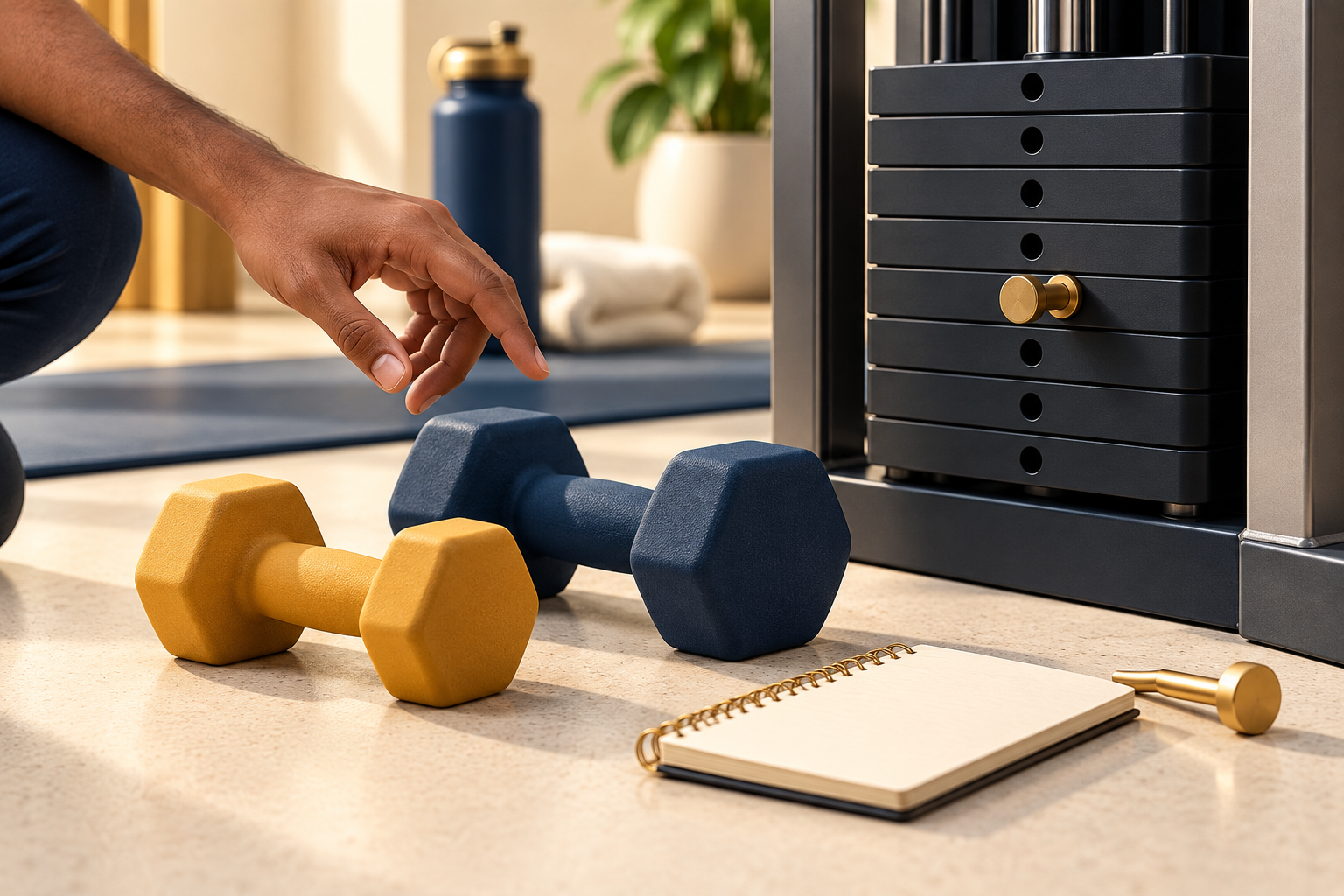
A fictional beginner tries a particular machine at a displayed 10 kg and completes twelve steady repetitions. The next marked setting is 15 kg. That is a 50% increase in the displayed number; the size of the gap is worth noticing. It does not become appropriate simply because it is the next hole.
If the higher setting makes the movement uncontrolled, return to a suitable setting and discuss another progression. Do not attach improvised objects to the machine. The figures here are arithmetic for an imagined machine, not a starting-load recommendation.
For a bodyweight movement, changing support, chair height or the exercise version can change difficulty. Progress need not arrive as a heavier dumbbell.
Your starting-load conversation
- Before the trial
Learn the setup
Identify the exercise, adjustments and comfortable movement with suitable instruction.
- One specific movement
Try, then record
Note the unit, actual repetitions and whether you maintained control. Rest before another attempt.
- No forced jump
Review the available change
If the next increment is too large, retain a suitable load and discuss another progression or version.
Write down enough to repeat the trial
Record the exercise, particular machine or equipment, relevant adjustments, displayed load and unit, actual reps, and a short control/effort note. “Row A, seat 3, 10 kg displayed, 12 steady reps; last few harder” is an illustrative entry. It is not transferable to another person.
Check whether a stack is labelled kilograms or pounds. Do not compare your number with somebody else’s machine or treat each dumbbell’s weight as the combined pair without saying so. If you change equipment, start a separate entry and reassess the setup and load.
The friend’s “ten” now has a better replacement: a specific movement, a recorded setting and a reason to repeat or adjust it.
Evidence: [2]
Build a starting point you can understand
Use the first few visits to make the setup familiar and the notes consistent. Add work according to your response and programme, rather than a rule that the weight must rise every Monday. If you have a health condition, injury or concerns about exercise suitability, seek appropriate healthcare guidance.
At IMFIT Madhapur, Angadh offers individual coached functional movement, strength and conditioning. Ask how the team helps select suitable movements and loads and reviews your progress. This is distinct from dedicated one-to-one personal training. Tell the team your experience and availability; they confirm any visit or session. Sunday is closed.
Questions people ask
Should beginners choose weights based on body weight or gender?
Neither supplies a universal answer. The exercise, equipment, experience, control and individual circumstances matter. A generic kilogram chart cannot observe how you perform the movement.
Should I copy the same weight on a different machine?
No. Different equipment can have different mechanics, adjustments and units. Learn the new setup and reassess an appropriate load rather than transferring the number.
Evidence: [2]
Build your next step
Sources and further reading
- ACSM: 2026 resistance-training position-stand summary; regular training, individualisation and equipment choice
- Mayo Clinic: weight-training technique, starting load, controlled repetitions and warm-up (21 January 2026)
- IMFIT: current membership and coaching formats
- IMFIT Angadh: individual coached functional movement, strength and conditioning
- IMFIT: current contact and enquiry details
Sources checked 2026-10-23.
This article is for general information and does not replace professional medical advice. Consult a qualified healthcare professional for guidance suited to your needs.
Choose your first working load
Ask about learning the setup, trying a suitable load and recording a clear starting point with coaching.
Discuss your starting point