The stairs are feedback, not a fitness score
Mild muscle soreness after unfamiliar exercise can settle over the next few days. Adjust activity to how you feel and function rather than forcing another hard workout. Sharp, worsening or limiting pain needs assessment; severe unexpected muscle pain, marked weakness or tea/cola-coloured urine needs immediate medical attention.
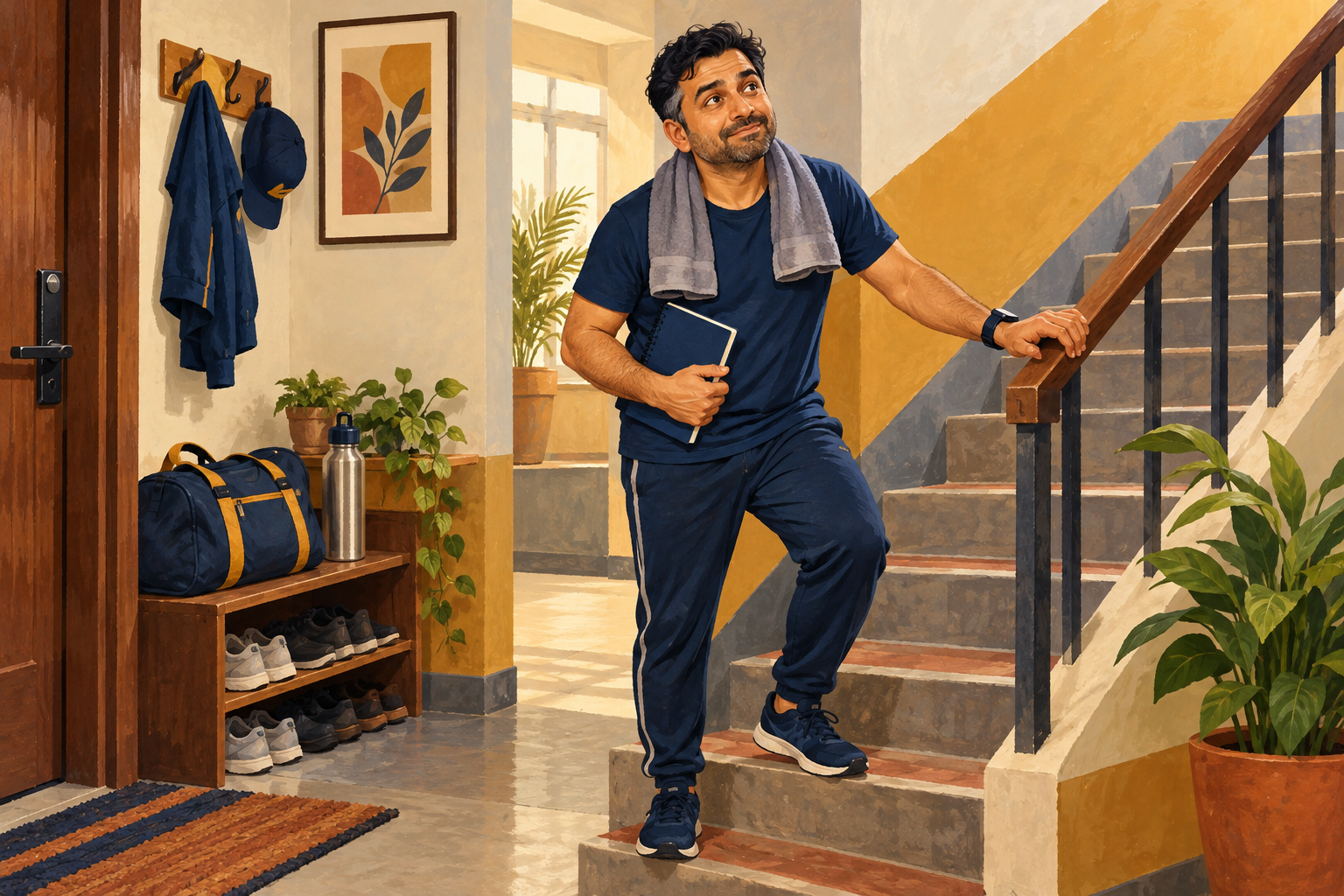
Imagine an office worker the morning after a first gym session, looking at the apartment stairs with new professional respect. The useful question is what to do next—not whether the stairs prove yesterday was effective.
Soreness does not measure the quality of a workout
New or unfamiliar exercise can be followed by delayed muscle soreness. It may feel dull and tender rather than like an injury at a particular moment. But timing alone cannot establish the cause: a symptom appearing later is not automatically harmless.
You do not need soreness after every session to make training worthwhile. Judge a beginner session by suitable work, learning and recovery, rather than how difficult sitting down becomes the next morning. This article cannot diagnose the pain you are experiencing.
A symptom guide, not a diagnosis
- Adjust and monitor
Mild and manageable
Dull soreness with ordinary movement largely manageable may allow comfortable gentle activity. Stop or reduce activity if it worsens.
- Get assessed
Limiting or concerning
Sharp, worsening, persistent pain or symptoms disrupting normal movement need appropriate assessment. Do not load through pain.
- Seek immediate medical attention
Severe pain, marked weakness or dark urine
Severe unexpected muscle pain, unusual marked weakness or tea/cola urine can be serious. Do not wait for all three signs.
Let severity, function and the trend guide the next conversation
With mild soreness that does not interfere substantially with ordinary movement, gentle activity may feel manageable. Keep it comfortable and reduce or stop if symptoms worsen. This is not an instruction to train the sore area hard to “flush it out.”
If pain changes how you walk or use an arm, limits everyday tasks, becomes worse, persists or concerns you, avoid loading it through pain and seek appropriate medical assessment. Do not use a calendar rule to declare yourself recovered. The fact that another session was planned is not evidence that it is appropriate today.
Evidence: [5]
Know the warning signs that override the workout plan
Severe muscle pain beyond what you would expect, unusual marked weakness or tea/cola-coloured urine after exertion can signal a serious problem, including rhabdomyolysis. Seek immediate medical attention if these occur. Do not wait for all three, and do not assume a hydration drink and a day off will rule it out.
Other concerning symptoms also warrant appropriate medical help. A coach or journal checklist cannot diagnose an injury or decide whether a serious condition is absent. CDC notes that symptoms can overlap with other problems; professional assessment is needed.
Evidence: [6]
Turn the next session into a review, not a punishment
For our imagined reader, the useful note is specific: what exercise was new, how much was completed, where symptoms are, whether normal movement is affected and whether they are improving or worsening. Share concerning symptoms with a healthcare professional; share training details with the coach when reviewing the programme.
If ordinary mild soreness is settling and activity is appropriate, the next session may need less work, an easier version or a different arrangement. That choice depends on the person and plan. Do not add work to compensate for a missed visit or repeat the session simply to prove resilience.
The memorable change is small: the stairs are no longer a trophy. They have prompted a better question about how to make the next week manageable.
Before deciding on the next workout
- Symptoms + ordinary tasks
Notice
Is movement affected? Is the problem settling, worsening or concerning? Follow the urgent guidance above if applicable.
- What was unfamiliar?
Record
Note exercises and actual sets/reps for a later training review. Do not delay care to complete a log.
- Adjust the next session
Discuss
Review an appropriate amount or movement version instead of repeating a punishing session or making up missed work.
What to ask before repeating the session
Ask which work was unfamiliar, how the starting amount was chosen and how the programme can be adjusted. Avoid treating online soreness remedies as a substitute for assessment. For health conditions, injury or uncertainty about suitability, get appropriate healthcare guidance.
At IMFIT Madhapur, Angadh’s individual coached functional movement and strength work can support a conversation about the training you completed and an appropriate next session. It is distinct from dedicated one-to-one PT and does not replace medical care. An enquiry is a request; the team confirms arrangements. Sunday is closed.
Questions people ask
Does no soreness mean the workout failed?
No. Soreness is not a required outcome. A suitable programme can build strength without making every following day uncomfortable; regularity and appropriate training matter.
Evidence: [1]
Can I assume dark urine is just dehydration?
No. Tea/cola-coloured urine, especially after exertion, is a warning sign that needs immediate medical attention. Symptoms can have overlapping causes; do not attempt to rule out a serious problem yourself.
Evidence: [6]
Build your next step
Sources and further reading
- ACSM: 2026 resistance-training position-stand summary; regular training, individualisation and equipment choice
- IMFIT: current membership and coaching formats
- IMFIT Angadh: individual coached functional movement, strength and conditioning
- IMFIT: current contact and enquiry details
- Cleveland Clinic: exercising with soreness and recognising concerning pain (4 April 2025)
- CDC NIOSH: rhabdomyolysis warning symptoms and immediate medical attention (14 January 2025)
Sources checked 2026-10-23.
This article is for general information and does not replace professional medical advice. Consult a qualified healthcare professional for guidance suited to your needs.
Review the training, respect the symptoms
For training questions, ask how coaching reviews your starting amount. For concerning symptoms, obtain appropriate medical care.
Discuss your starting point