Start with a week you can repeat
Begin with two strength sessions separated by recovery days. Learn a small set of movements, record what you actually do and adjust only when the movements and recovery are manageable. The four-week example below shows how—not a test you must pass.
An imagined beginner has saved six workout routines on her phone. Her gym bag is ready. Her decision is not. The first useful change is smaller than a new exercise: she chooses two days she can genuinely attend.

Before you follow the example
This is an introductory learning template for generally healthy adult beginners. It is not a personalised programme, a rehabilitation plan or a promise of results in four weeks. The specific exercise menu and weekly checkpoints are editorial examples assembled from the guidance below; the exact four-week package has not been tested as a programme.
If you have an injury, health condition, recent operation, pregnancy/postpartum considerations or concerns about symptoms or exercise suitability, get appropriate healthcare guidance first. Use a qualified fitness professional to learn unfamiliar movements and equipment. You can shorten the session, repeat a week or choose an appropriate alternative; finishing a checklist is not more important than exercising suitably.
A week with room to recover
- Strength sessions
Monday + Thursday
Use the same suitable starting menu. Learn the setup, practise, train and write your notes.
- Recovery + movement
The days between
Tuesday/Wednesday and Friday–Sunday separate the strength sessions. Include suitable everyday movement; another hard session is not required.
Put two sessions in your calendar
For this example, choose Monday and Thursday for the same whole-body starting session. Tuesday and Wednesday leave two days between strength sessions; Friday to Sunday leaves three. Tuesday and Friday would work just as well for someone with a different week.
A repeatable session makes it easier to learn the setup and compare like with like. You do not need a different body-part workout every visit. Twice-weekly muscle-strengthening is consistent with general adult guidance; the exact days here are simply an example.
In the imagined scene, Monday and Thursday fit. Six saved routines do not create six free evenings. The useful plan now has somewhere to live in her actual week.
Read the numbers before choosing the weight
A repetition, or rep, is one complete movement. A set is a group of repetitions before you rest. “1 set of 12–15 reps” means do the movement up to that range with appropriate control, then rest—not fifteen sets.
The machine press and row in this example use one set of 12–15 reps once you have learned them. The bodyweight practice exercises start with five controlled repetitions. Those are different starting examples, not a rule that every exercise needs the same count. Stop earlier if control is lost or the movement causes pain.
A light practice attempt used to learn a setup is not a demand to add another hard set. Keep a note of what was practice and what you counted as training.
Your session: prepare, practise, train, note
First, warm up with about 5–10 minutes of comfortable walking or another suitable easy aerobic activity. Start at a pace appropriate to you. Before each unfamiliar exercise, learn the setup and try the movement without chasing effort.
Then work through the five movements below in order, one at a time. Complete the suggested starting set, rest for roughly a minute and take longer when needed to settle your breathing and prepare the next movement. This is a practical starting arrangement, not a stopwatch challenge. Do not rush straight into the next exercise because an app beeps.
Finish by easing the activity down and writing your notes. Allow room for instruction and normal pauses. A short session you understand is more useful than filling an arbitrary hour with unfamiliar exercises.
Five movements to learn—not five stations to rush through
Use this menu as a starting example to discuss and practise with appropriate guidance. A stable chair, two familiar machines and a mat are enough for this version. They are not compulsory equipment or the only effective choices. The press and row involve the arms and shoulders as well as the chest and back; the lower-body and floor movements give the session its other jobs.
Read each movement’s cue and starting amount below. The cited pages include further instructions or demonstrations. A short written cue cannot show whether your own setup is correct. If a movement does not suit you, use an appropriate alternative with guidance instead of forcing it to complete the list.
Learn the movement. Keep the note.

Your starting session: five movements
- 1 set · 5 reps
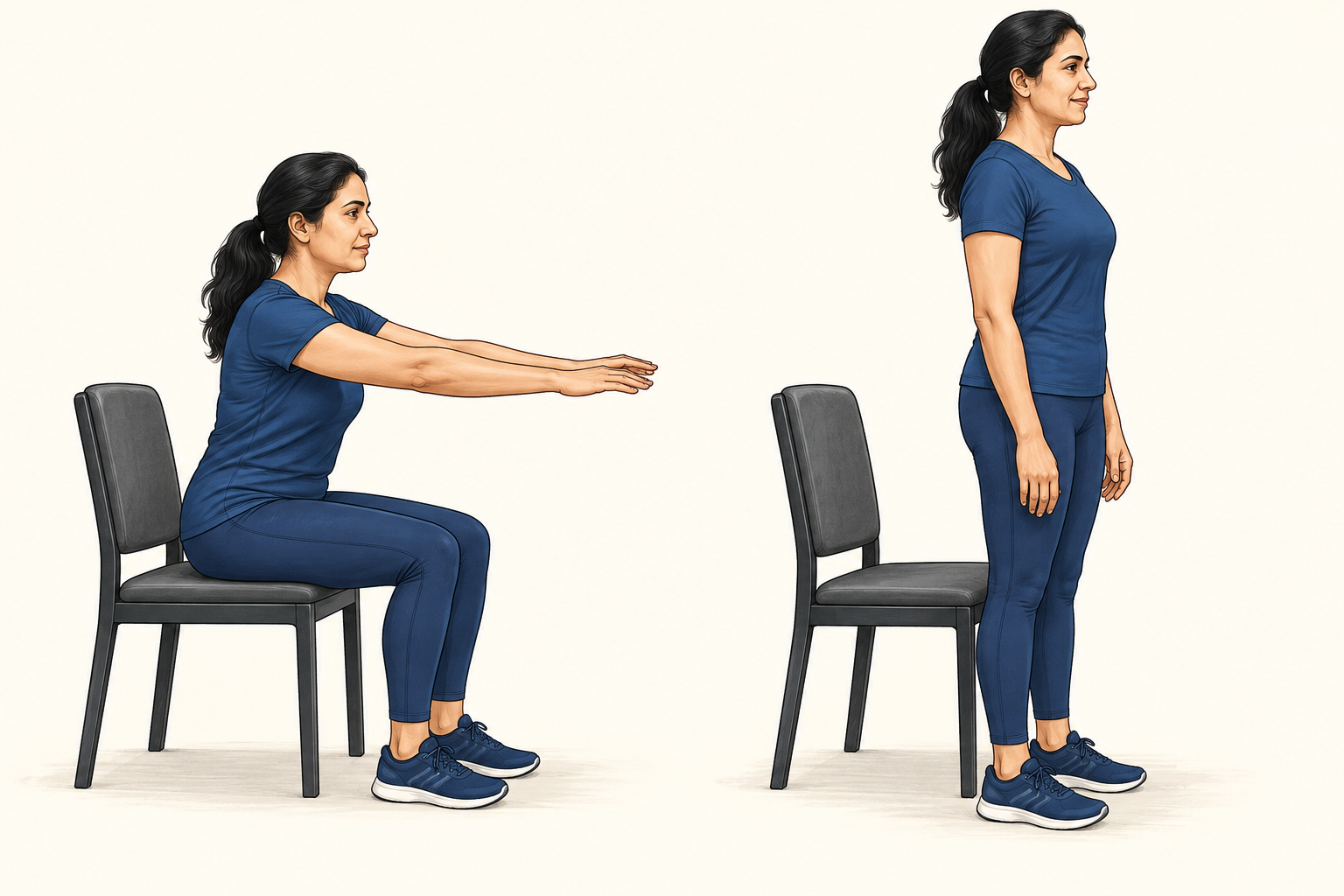
Sit-to-stand · legs and hips
Use a stable, non-wheeled chair that cannot slip. Feet flat, lean slightly forward, stand using your legs, then sit slowly. Use guidance/support as needed. Record chair height and assistance. Build gradually rather than adding a weight immediately.
- 1 set · 12–15 reps
Machine chest press · pushing
Have the seat adjusted so grips sit at or just below shoulder height. Press and return smoothly; avoid arching your back or locking the elbows. Start lighter if control is difficult. Record the machine, seat setting and displayed load/unit.
- 1 set · 12–15 reps
Seated row · pulling
Learn the machine position and grip. Pull the handle towards your waist and return with control; do not use a large forward lean or swing to move the load. Record the same setup and how many controlled repetitions you completed.
- 1 set · 5 practice reps
Bridge · hips and trunk
Lie on a mat with knees bent. Tighten your abdomen and lift the hips into line with knees and shoulders, without forcing an arch. Hold for three comfortable breaths, then lower. Five is this example’s initial practice count; the source describes the movement, not this four-week dose.
- 1 set · 5 practice reps
Abdominal crunch · trunk control
Feet flat, knees comfortably bent and arms folded on your chest. Gently raise head and shoulders, hold for three comfortable breaths and lower. Do not pull your head with your hands. Stop when control is lost; this low practice count is an editorial starting example.
Choose a starting weight without guessing kilograms
For the machine press and row, first learn the controls and practise with a light setting. A suitable training weight should allow the intended repetitions with steady movement and manageable effort. It should not require a sudden heave, breath-holding or somebody lifting it for you. The final repetitions may feel harder, but you do not have to keep going until another repetition is impossible.
If control breaks down before the range, stop the set and choose a lighter setting for the next attempt. If the full range is very easy, a small increase may be appropriate once the setup is familiar. For bodyweight movements, changing the support or movement version can change difficulty without adding a dumbbell.
There is no useful universal “beginner weight” for every person and machine. Record the machine and its displayed unit. A number on one machine is not a direct comparison with the same number on another.
Four weeks, four jobs
The calendar does not earn you a heavier weight. Your control, effort and recovery tell you whether a change makes sense. Keep the same basic session while you learn, rather than changing all the exercises each Monday.
Week 1 is for finding suitable versions and understanding the setup. Week 2 is for repeating them and making the notes more useful. During weeks 3 and 4, an extra set or a small load change can be considered where appropriate—but neither is compulsory. These week labels are an editorial learning sequence, not a study-proven progression rule.
Before adding work, check that you can repeat the movement with control, understand its setup and recover enough for the next planned session. If not, repeat the current amount or discuss an adjustment. A bodyweight exercise may need a better-suited version rather than more repetitions.
A concrete example for week 3: if the row is familiar and current work is manageable, keep its load unchanged and try a second set after resting. Record both sets separately. If the second set loses control, stop it rather than forcing the count. In week 4, repeat and review that change before also increasing the load. The example changes one exercise—not the whole session at once.
What each week is for
Week 1 · learn
Two suitable sessions. Find your exercise versions, settings and manageable starting amounts. Write them down.
Week 2 · repeat
Use the same versions and compare your notes. Keep the amount if technique, effort or recovery still needs attention.
Week 3 · consider one change
If current work and recovery are manageable, one example is a second set of the learned row at the same load. Rest, reassess and record both sets. Otherwise repeat the current amount.
Week 4 · review
Compare the same movement and setup. Keep, adjust or seek more individual support. No automatic weight increase and no transformation deadline.
A useful log beats another saved routine
Write the exercise or machine, relevant setup, load and unit, repetitions, how the movement felt, and one next-step note. “Did gym” cannot tell you whether to repeat a load. “Row: same machine, 12 smooth reps, last two felt harder, no swinging” can.
Here is a deliberately fictional example. On one visit, the beginner records 12 controlled row repetitions on a particular machine. On another visit with the same setup and displayed load, she records 15 controlled repetitions and notes that the effort feels manageable. That gives her a reason to discuss a small increase—not proof that a new setting is automatically suitable.
After a change, reassess rather than demanding the same count immediately. If a machine’s smallest increase is too large to control, keep the previous setting and ask about another appropriate progression. Change one thing at a time so the log remains understandable.
Three notes worth taking to your next session
What did I use?
Exercise or machine + seat/support setting + load and unit. Example: row, machine A, seat 3; write the actual displayed load.
What did I do?
Sets and controlled reps + a short effort/technique note. Example: 1 × 12; last two harder, no swinging.
What is the next choice?
Repeat, adjust with guidance, or ask a specific setup question. A log is information for a decision—not an instruction to lift more every visit.
When the week does not go to plan
Missed Monday? Wednesday and Saturday can be an alternative in this example, leaving recovery days between sessions. Do not squeeze two full-body strength sessions into consecutive days simply to tick off the week. Resume a feasible pattern; you do not owe the gym a punishment session.
Only a little time? Keep the warm-up, appropriate practice and the movements you can do properly. Record what you omitted. The shorter visit is a partial session, not an equivalent dose to the full example; discuss how to arrange the next one.
Machine occupied? Ask about a suitable alternative or change the order where appropriate. A substitute may have a different setup and load, so record it separately. Do not copy the old machine’s number onto a different piece of equipment.
Include ordinary movement and recovery
Strength training is one part of an active week. General adult guidance also includes aerobic activity: at least 150 minutes of moderate activity a week, or an equivalent vigorous combination. That is a broader health target, not a demand to start at the full amount on day one. Build from what you currently manage. Walking can be one accessible option.
On the days between strength sessions, comfortable everyday movement may fit; you do not need another hard workout for the day to count. Make space for sleep and recovery. Soreness is not the objective of the plan.
Stop an exercise if it causes pain or you become unwell. Seek appropriate assessment for concerning, persistent or worsening symptoms. Persistent chest discomfort, especially with breathlessness or feeling faint, requires urgent medical help. Do not use a training log to decide that a worrying symptom is harmless.
What should be clearer by the end of week four?
You should have a more useful set of questions: which movements suit your starting point, how the equipment is adjusted, what you actually completed and what might change next. The four-week mark is a review point, not a guaranteed transformation deadline.
Our imagined beginner does not need to emerge with a new body or a perfect attendance record for the story to have a practical ending. Her next sensible choice would be to bring the small notebook and ask about one recorded movement—not download routine number seven.
Before the next month, review the log, the week you can sustain and whether you need different guidance. You may repeat the same structure, adjust it or move to a more tailored programme. Choose the next step from what you have learned.
Evidence: [1]
How IMFIT can help with the starting point
At IMFIT Madhapur, Angadh offers individual coached movement, strength and conditioning. Ask for help choosing suitable starting movements, learning their setup and understanding how your training is reviewed. Individual functional training is distinct from dedicated one-to-one personal training. This article’s example is not a promise that IMFIT runs this exact session or four-week programme.
Tell the team your starting experience, goal and available days, and ask what support and session times are available. A visit or session is confirmed by the team; sending an enquiry does not reserve a workout. Sunday is closed. The membership guide explains the different coaching formats and fees.
Questions people ask
Can I do this three times a week instead?
The example uses two strength sessions. Three may suit some people, but it changes the week’s training amount and recovery demands. Do not add the extra day automatically. Review what you can manage and arrange suitable recovery with guidance.
Will this plan make me lose weight in four weeks?
This is a training-learning guide, not a guaranteed fat-loss programme. Scale change depends on more than completing strength sessions. Use the separate fat-loss guide to understand the distinction, and assess training progress without requiring a particular four-week weight change.
Evidence: [1]
What if floor exercises or the chair movement do not suit me?
Do not force them or improvise a painful version. Discuss an appropriate alternative and how its setup and amount differ. Injury, health concerns or difficulty getting to and from the floor may require professional input; the example is not a personalised prescription.
Build your next step
Sources and further reading
- ACSM 2026 resistance-training update: regular participation, individualisation and failure not required; checked 22 October 2026
- American Heart Association: regular strength training and recovery; checked 22 October 2026
- Mayo Clinic, January 2026: weight, technique, warm-up, rest and breathing; checked 22 October 2026
- NHS: stable chair and sit-to-stand instruction; checked 22 October 2026
- Mayo Clinic: machine chest-press instruction and repetition example; checked 22 October 2026
- Mayo Clinic: seated-row instruction and repetition example; checked 22 October 2026
- Mayo Clinic: bridge movement instruction; not evidence for this guide’s practice count; checked 22 October 2026
- Mayo Clinic: abdominal-crunch instruction; not evidence for this guide’s practice count; checked 22 October 2026
- CDC: adult aerobic and muscle-strengthening guidance; checked 22 October 2026
- NHS: warm-up guidance and exercise-safety information; checked 22 October 2026
- NIDDK: gradual start and appropriate activity; checked 22 October 2026
- IMFIT: current contact, enquiry and confirmation details; checked 22 October 2026
- IMFIT: membership formats and trainer guidance; checked 22 October 2026
- IMFIT Angadh: individual coached movement, strength and conditioning; checked 22 October 2026
- NHS: chest discomfort with concerning accompanying symptoms; checked 22 October 2026
Sources checked 2026-10-22.
This article is for general information and does not replace professional medical advice. Consult a qualified healthcare professional for guidance suited to your needs.
Bring your starting point—not a perfect plan
Tell IMFIT your goal, experience and available days. Ask about suitable starting movements, guidance and session availability before choosing a programme.
Discuss beginner training