A lower percentage is not proof of fat loss
A smart scale estimates body fat; it does not measure fat tissue directly. Accuracy varies by device and person. Two readings alone cannot tell you how much fat you lost. Check their circumstances before changing your food or workout.
What the scale measures—and what it calculates
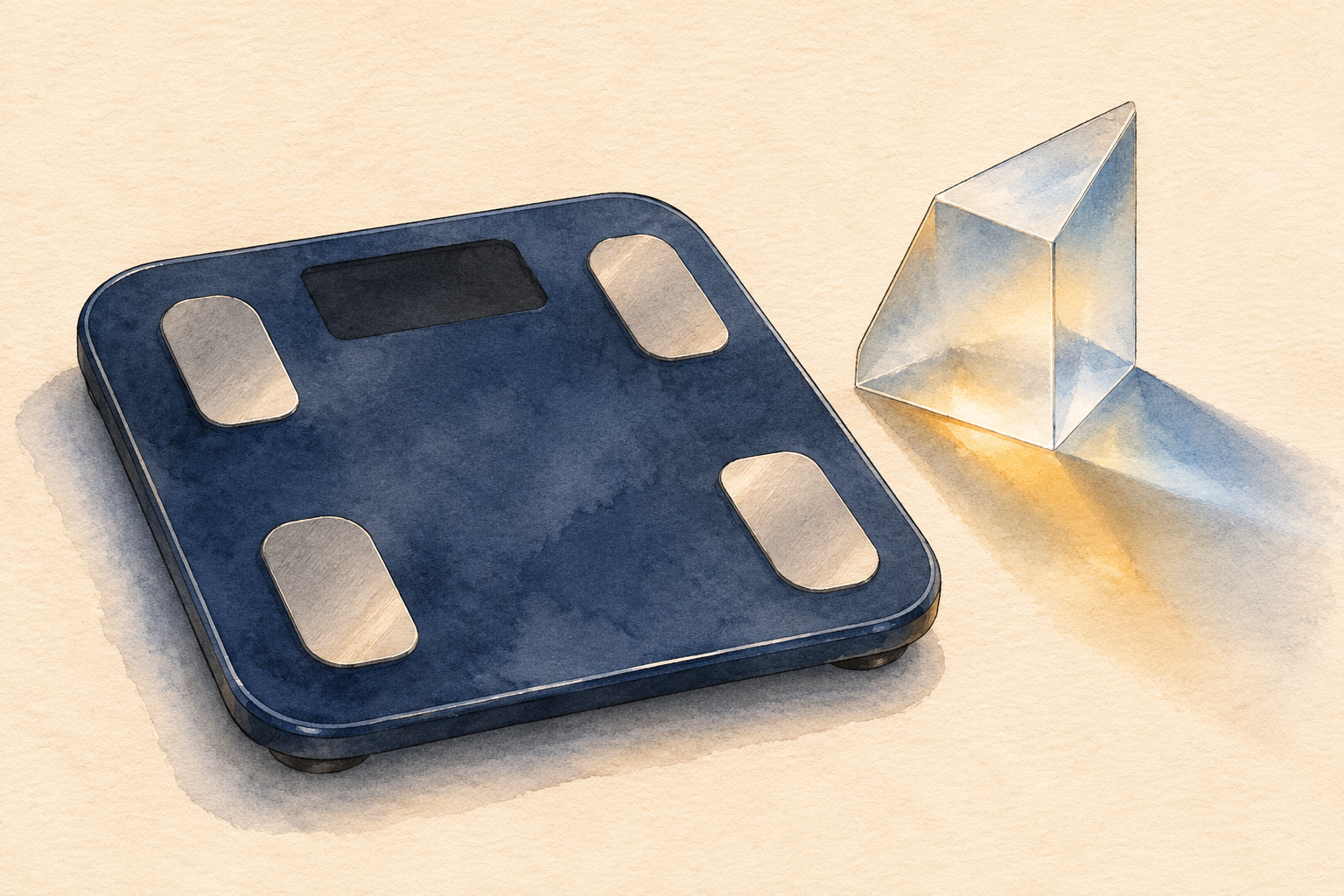
A typical body-composition scale combines a weighing scale with bioelectrical impedance analysis, or BIA. The device measures the body’s opposition to a small electrical signal. Its prediction model uses that information, often alongside details such as height, weight and age, to estimate body composition. It does not see or weigh your fat tissue directly.
That distinction explains why a scale can give a useful weight reading while its body-fat estimate is less accurate. The two outputs do not come from the same measurement process. A polished app, decimal place or extra category does not remove the assumptions behind an estimate.
Device design, the prediction equation and how well its validation sample represents the person using it all matter. One model’s results cannot establish the accuracy of every bathroom scale or a different gym analyser. Follow your device’s actual instructions; a generic internet protocol cannot validate its equation.
What sits behind a body-fat estimate?
Fat %
The measurement
Electrical impedance and the weighing measurement provide inputs; neither directly weighs fat tissue.
The model
The device uses an equation and assumptions to turn inputs into body-composition estimates.
The fit and conditions
Validation populations, device design and measurement procedure limit how the result applies to you.
What the research can actually tell you
In a 2021 French hospital study, three consumer smart scales were compared with DXA assessments. They performed much better for body weight than for body composition. These were three older models, tested in separate patient groups, not a ranking of today’s Indian market. The study cannot tell you the exact error of the scale in your bathroom.
A 2026 systematic review assessed BIA against a four-compartment reference model in 12 studies involving healthy, weight-stable adults. Small average differences sometimes existed alongside wide differences for individuals. An acceptable group average therefore did not establish that a particular person’s result was interchangeable with the reference assessment. The review combined different device types and reference-model methods; it was not a consumer-brand league table.
Both examples concern agreement with a reference assessment. They do not automatically validate a device’s ability to detect your small week-to-week changes. Repeatedly seeing the same number is not, by itself, proof that the number is accurate.
Two readings, one tempting conclusion
Consider an imagined example, not a member result. A beginner records 80 kg and 30% body fat on Device A during the usual morning routine. Another reading after a gym visit shows the same 80 kg but 28%. The number looks encouraging, but the circumstances differ.
First, name the change correctly: 30% to 28% is a fall of two percentage points. It is not automatically two kilograms of fat, or a 2% reduction in the original percentage.
Now calculate what those estimates imply. At 80 kg, 30% represents 80 × 0.30 = 24 kg of estimated fat mass. At the same weight, 28% represents 80 × 0.28 = 22.4 kg. The difference is 1.6 kg in the estimate. That arithmetic is correct; it does not prove that 1.6 kg of fat was lost or that muscle replaced it. Neither record tells us the true tissue change, and the example does not identify what caused the display to move.
Keep both original readings with their context. For a later reading, use the same device and follow its preparation instructions rather than joining unlike records into a progress claim. Comparable circumstances help you interpret the record; they still do not validate the device’s accuracy. There is no reason from these two entries alone to add a harder finisher or cut food.
Same weight, different body-fat estimates
- 30%
Reading one · 80 kg
Device A; usual morning routine. Calculated fat estimate: 80 × 0.30 = 24 kg.
- 28%
Reading two · 80 kg
Device A; after a gym visit. Calculated fat estimate: 80 × 0.28 = 22.4 kg.
Consistent conditions help interpretation; they do not calibrate the scale
For any future measurement you choose to take, follow the manufacturer’s setup and preparation instructions. Keep the same device and procedure, and record departures from your usual circumstances, such as a reading after exercise. Switching devices and joining their percentages into one progress line creates another comparison problem.
Do not assume one glass of water explains a particular change. A 2026 study of 98 healthy young adults compared measurements on a water-intake day and a banana-intake day. Most outcomes did not show different time responses between those days. Intake type was fixed to day order and there was no no-intake control, so it cannot establish a universal food-or-water effect or a trick for improving a score.
Standardising the procedure reduces avoidable differences in how a measurement is taken. It does not turn an unvalidated estimate into an accurate assessment or guarantee that its trend tracks true fat change.
Use a progress record that can answer a training question
For our imagined beginner, the next step is to keep the two entries separate and describe their circumstances. A change in the estimate is a reason to check the comparison, not an instruction to rewrite the workout.
If the question is “Am I getting stronger at this exercise?”, an entry naming the exercise, setup, resistance and completed repetitions addresses that task more directly. If the question is a clinical body-composition assessment, ask a qualified healthcare professional which method and interpretation are appropriate. You do not need to buy a body-fat scale or arrange a scan to begin ordinary gym training.
At IMFIT Madhapur, bring an exercise entry and the change you are considering—for example, adding a finisher because a scale result disappointed you. Angadh includes individual movement practice with shared trainer demonstrations and corrections; Strength & Cardio includes equipment and technique guidance. Ask how your actual training record should inform the next step. Dedicated one-to-one personal training is a separate service.
An enquiry is a request; the team confirms arrangements. Sunday is closed. The useful endpoint is a clearer decision about your current plan, not a more impressive number in an app.
Questions people ask
Can I subtract a fixed error from every reading?
No universal correction follows from these studies. Device equations, people and individual errors differ. An average bias from a study is not your personal calibration, and a measurement from another device is not automatically interchangeable.
Does a repeated result prove the trend is accurate?
No. Repeatability and accuracy are different questions. Repeating a procedure can reduce some sources of variation, but a stable bias or an unvalidated prediction can remain. Reference agreement at one time also does not prove accurate tracking of change.
Evidence: [2]
Build your next step
Sources and further reading
- Frija-Masson et al., 2021: three consumer smart scales compared with DXA in French hospital patients
- Oliver et al., 2026: BIA versus four-compartment assessment; 12-study systematic review and individual agreement limits
- Čermáková et al., 2026: water/banana intake and BIA; fixed-order design and interpretation limits
- IMFIT membership: coaching formats and shared guidance; checked 28 November 2026
- IMFIT contact: Sunday closure and team-confirmed arrangements; checked 28 November 2026
Sources checked 2026-11-28.
This article is for general information and does not replace professional medical advice. Consult a qualified healthcare professional for guidance suited to your needs.
Bring the reading—and the question behind it.
Bring one exercise entry and the change you are considering. Ask about Angadh’s shared movement guidance or Strength & Cardio’s equipment and technique support, so the discussion starts with the training you actually do.
Discuss your training planWas this useful?
A little feedback helps us choose what to explain next.
Your questions & thoughts
What would help you put this into practice?
Comments appear after review. Keep it kind and relevant; please leave out phone numbers, medical details and other private information.
Loading reader comments…
Leave a comment +