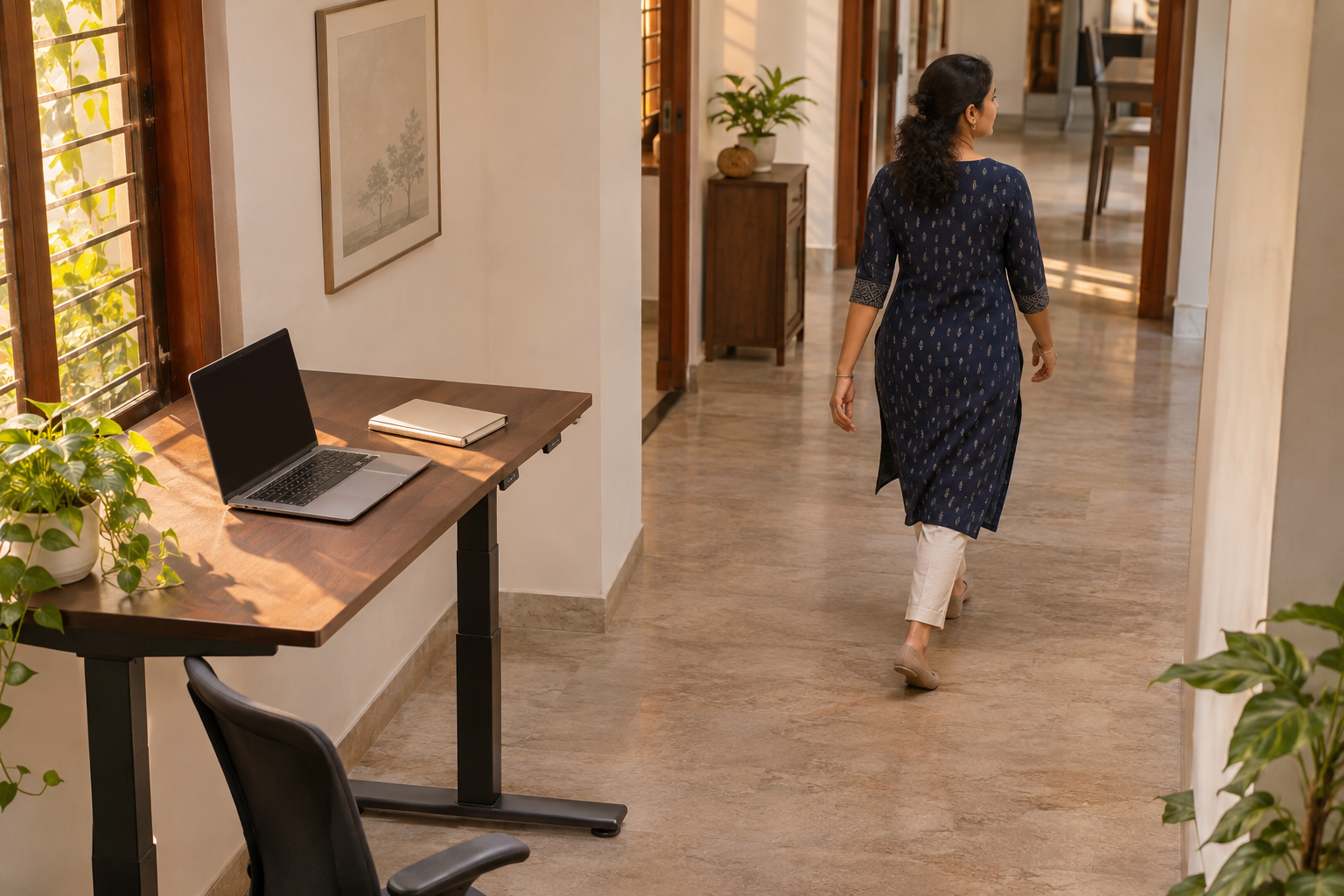
The desk can rise. You can still stay put.
A standing desk can help you change position, but standing still is not the same as a walking break. If walking is suitable for you, make room for movement breaks alongside regular exercise. You do not need to stand all day.
An imagined workday: a Hyderabad professional raises her new desk before opening her inbox. By afternoon, she has answered plenty of emails without going anywhere. The desk has travelled further than she has.
Give posture and movement separate jobs
WHO describes sedentary behaviour as low-energy waking time spent sitting, reclining or lying. Standing up changes that posture. Walking around also adds bodily movement; the two actions are not interchangeable.
This gives our imagined desk worker two useful questions: “Have I stayed in one position for a long stretch?” and “Where can I actually move?” Raising the screen answers neither question automatically for the rest of the day.
NIOSH says office work should not require sitting or standing for too long. Look at the task and setup, not just the furniture. Alternating positions can be useful; replacing an entire seated day with an entire standing day is not the goal.
One active day has more than one job
3 jobs
Change position
Alternate sitting and standing when suitable. Avoid staying fixed in either posture.
Add movement
Use a feasible break to move, such as a comfortable walk along a safe route.
Keep training
Make room for suitable aerobic activity and muscle-strengthening across the week.
What the research adds—and where it stops
A 2022 review combined seven one-day experiments comparing continued sitting, standing breaks and light walking breaks. Walking produced larger improvements in post-meal glucose and insulin responses than standing. Standing also improved the glucose response compared with continued sitting in the pooled analysis.
Most participants had overweight or obesity, protocols varied, and the experiments measured short-term markers. This does not prove that a particular desk or break schedule prevents disease, produces fat loss or suits every office worker. Nor does it make standing pointless. It supports keeping posture change and movement distinct.
India’s ICMR–NIN dietary guidelines also suggest opportunities to stand and walk during busy days. The useful idea is to create opportunities you can use, rather than turn every meeting into a rigid exercise alarm.
A small plan that survives a meeting
For an illustrative trial of the routine, our desk worker chooses two possible gaps: after the morning screen-sharing meeting and after finishing an afternoon document. At each, she could take an easy indoor walk along a clear corridor and back. She puts the phone away before moving.
Suppose each walk happens to take two minutes. Two completed walks would add four minutes of light movement; standing during a separate call would remain a posture change, not extra walking minutes. These times are teaching assumptions, not a recommended dose or a minimum needed for benefit.
Now let the morning meeting run into the next call. She records that first walk as missed and uses the next feasible gap. If only the afternoon walk happens, her note says “one walk, about two minutes”—not four minutes because two were planned.
The practical change is a cue, a usable route and an alternative when work interrupts. If breaks are routinely impossible, discuss workload and break opportunities with the workplace; a better reminder cannot create permission to leave a live task.
Save a break you can actually take
- Meeting ends
The cue
Example: finish the morning meeting or afternoon document, then take an available movement break.
- Clear corridor
The route
Example: walk to the corridor end and back comfortably. Put the phone down; keep walkways clear.
- Next gap
The fallback
If work overruns, use a later opportunity. Record what happened; do not count a planned walk as completed.
Keep the gym—and the rest of the day—in view
Light movement breaks have a place even when they are not demanding enough to count as moderate-intensity aerobic activity. WHO recommends both limiting sedentary time and being physically active; strengthening remains part of an active routine. The linked effort guide explains why a movement’s name alone does not tell you its intensity.
A few easy corridor walks do not become a strength session, and a gym visit does not change how the preceding desk hours were spent. Plan both without treating one as punishment for the other. Build from your ability and seek individual healthcare guidance when a condition, pain or uncertainty affects suitable activity.
Our imagined worker can keep the adjustable desk. Her next useful change is to name an actual movement opportunity, then notice whether it happens. The desk does not need to be discarded—or promoted to personal trainer.
Bring the whole workday to your training conversation
At IMFIT Madhapur, ask how suitable aerobic activity and strength work fit around a desk-heavy week. Angadh offers individual lifting and movement practice with shared-floor trainer demonstrations and corrections. Dedicated one-to-one PT is a separate format.
A useful question is: “I can attend these days, and most of my work is stationary. What should my training cover, and what movement could fit outside the gym?” This is a training discussion, not a workplace ergonomic assessment or medical treatment. Sunday is closed; the team confirms visits after an enquiry.
Questions people ask
Do I need to buy a standing desk first?
No. Movement opportunities can come from changing tasks or taking feasible breaks. A suitable workstation matters, but a purchase is not a prerequisite for planning movement. Discuss persistent discomfort and setup problems with appropriate workplace or healthcare support.
What if walking is not a suitable option for me?
The corridor example is optional. Ask a qualified professional about movement suited to your abilities and circumstances, including seated or wheeling options where appropriate. Do not force standing or walking to copy someone else’s routine.
Evidence: [1]
Build your next step
Sources and further reading
- WHO: physical activity and sedentary behaviour, updated 4 November 2026 (accessed 6 November 2026)
- Buffey et al., Sports Medicine (2022): standing/walking interruptions; seven one-day trials and limitations (accessed 6 November 2026)
- ICMR–NIN, Dietary Guidelines for Indians (2024), p. 71: busy-schedule movement opportunities (accessed 6 November 2026)
- CDC/NIOSH: Office Environments and Your Safety, July 2026; posture, tasks and workplace constraints (accessed 6 November 2026)
- IMFIT: current training formats and separate one-to-one PT (accessed 6 November 2026)
- IMFIT: opening days and visit confirmation (accessed 6 November 2026)
- CDC: relative aerobic intensity and the talk test; light movement is not automatically moderate (accessed 6 November 2026)
Sources checked 2026-11-06.
This article is for general information and does not replace professional medical advice. Consult a qualified healthcare professional for guidance suited to your needs.
Plan for the hours outside the gym too
Tell the team your experience, available training days and desk-heavy routine. Ask which coaching format suits the training you want to learn.
Compare coaching formatsWas this useful?
A little feedback helps us choose what to explain next.
Your questions & thoughts
What would help you put this into practice?
Comments appear after review. Keep it kind and relevant; please leave out phone numbers, medical details and other private information.
Loading reader comments…
Leave a comment +