Before you press “buy”
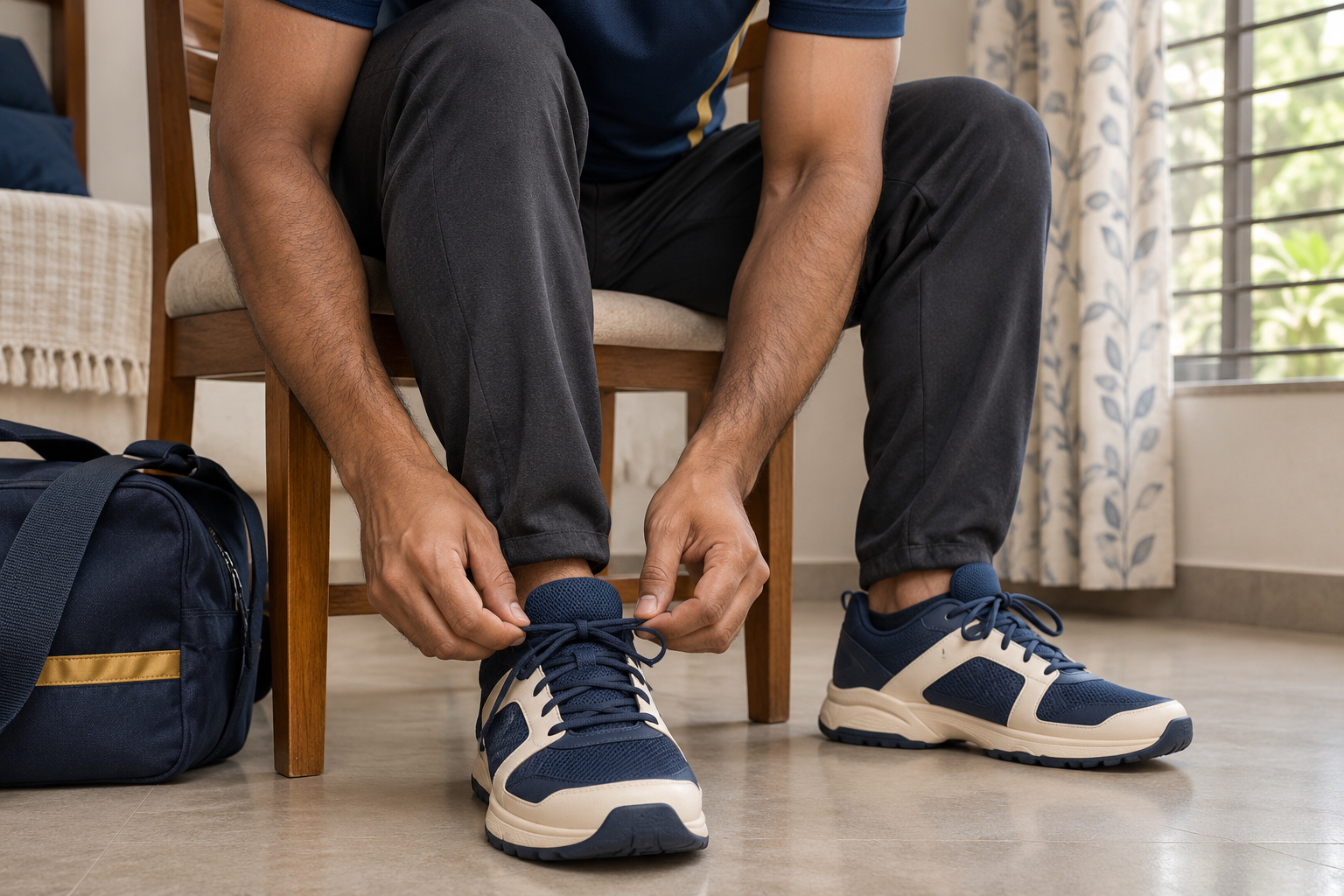
An imagined Sunday-evening dilemma: a Hyderabad beginner has put lifting shoes in his basket before his first gym visit.
You don’t automatically need a specialist pair. First check whether your shoes fit securely, grip the surface and suit the activities planned. Raised heels can change squat mechanics; that alone doesn’t show you need them.
Match the job, then check the shoe
The American Academy of Orthopaedic Surgeons advises choosing footwear for the activities you do. It notes that a cross-training shoe may suit someone doing several forms of exercise. Running, lifting and a mixed session are different briefs; an athletic-looking shoe is not a guarantee that it suits all three.
A raised-heel lifting shoe also changes the setup. A 2026 review of 14 studies involving 177 participants found that heel elevation changed ankle and knee movement during squatting. That is evidence about joint mechanics. It is not proof that a beginner needs a particular heel height, will lift more, or will avoid injury by buying that shoe.
Three questions behind a shoe choice
Your shoe choice
What will you do?
Running, lifting or a mixed session: start with the activity, not the product label.
What does the heel change?
Heel elevation can change joint movement in squat studies. That does not identify your ideal shoe.
Does the pair fit and grip?
Check secure fit, toe room and traction. Specialist features do not replace these basics.
A balance result is not a barefoot rule
Another 2026 pilot study compared squat exercises in eight resistance-trained men. Their usual sports shoes changed force-plate measures more during the split squat than during the two-foot back squat. That tells us the exercise matters when interpreting a footwear result.
There is an easily missed detail: the “unshod” condition was performed in socks, not with bare skin on the floor. Shoe models were not standardised either. This small study did not establish long-term injury rates or a best shoe for Indian beginners. Copying its comparison by taking your shoes off would turn a limited laboratory finding into a gym rule it did not test. Mayo Clinic’s everyday guidance is to wear footwear that protects the feet and provides traction.
Try the pair you have with a clear question
Return to our imagined beginner. His planned visit includes learning some free-weight movements and discussing where cardio fits. Before ordering a specialist pair, he can describe that mix and ask what footwear the session needs.
He can put on both current shoes with his usual activity socks, secure the laces and walk around. Does either heel slide inside the shoe? Do his toes feel cramped? Those are specific fit concerns to describe. If the pair fits, he can still ask the coach to review it for the planned movements before adding load. A fit check is not proof that every exercise will suit it.
Use the same fit checks when trying a new pair. A higher price or taller heel cannot answer them. A shoe that pinches or slips is not a reason to force an exercise.
Take these checks before checkout
Name the activities
Tell the coach which movements and cardio you plan to do, rather than asking only “Is this a gym shoe?”
Check both feet
Use your usual activity socks, secure the laces and check heel hold and toe room in both shoes.
Review a specific problem
Describe slipping, pinching or loss of control. Stop painful exercise; don’t treat a new heel height as a diagnosis.
Keep the next visit about learning
The useful next step is a footwear-and-session conversation, not a shopping deadline. A raised-heel option may be relevant to a particular lifting setup; a mixed routine may lead to a different choice. Neither conclusion should come from one social-media clip or the height of the sole alone.
If exercise causes pain, stop it rather than trying to solve the problem by buying a shoe. Persistent foot pain, a known foot condition or a prescribed orthotic needs advice from a qualified healthcare professional about footwear and activity. A coach’s movement review does not replace that assessment.
Bring the question to the gym floor
At IMFIT Madhapur, Angadh includes individual free-weight and movement practice with shared trainer demonstrations and corrections. The trainer also works with others; it is distinct from dedicated one-to-one PT. That is a practical place to discuss how your shoes and the planned movements work together, without treating a specialist purchase as the whole answer.
Our imagined beginner can bring the pair he owns and explain the activities he wants to learn before placing that order. IMFIT is closed on Sunday; discuss a Monday–Saturday visit with the team. An enquiry is a request, and arrangements are confirmed by the team.
Questions people ask
Can one pair cover a mixed gym session?
Possibly. AAOS says cross-training footwear may suit several activities, while a regular single-sport focus may call for a more specific shoe. Describe your actual session and assess fit rather than assuming every trainer is interchangeable.
Evidence: [1]
Do I need to copy a study’s heel height?
No. A study condition is not a personal fitting instruction. Your planned movement, comfort and control need review; a heel-height finding does not diagnose why a squat feels difficult.
Build your next step
Sources and further reading
- AAOS OrthoInfo: athletic footwear, activity matching and fit checks (checked 15 November 2026)
- Heel elevation and squat joint range: systematic review and meta-analysis (2026; author abstract checked 15 November 2026)
- Footwear and squat stability: pilot study in eight trained men (2026; full text checked 15 November 2026)
- Mayo Clinic: weight-training technique, protective footwear, traction and pain guidance (checked 15 November 2026)
- IMFIT: current membership formats; shared Angadh guidance also owner-confirmed 25 October (checked 15 November 2026)
- IMFIT: opening days and team-confirmed visit requests (checked 15 November 2026)
Sources checked 2026-11-15.
This article is for general information and does not replace professional medical advice. Consult a qualified healthcare professional for guidance suited to your needs.
Discuss the shoes and the session
Bring your current pair and explain what you want to practise. Ask how the footwear suits the movements planned.
Discuss a visit with IMFITWas this useful?
A little feedback helps us choose what to explain next.
Your questions & thoughts
What would help you put this into practice?
Comments appear after review. Keep it kind and relevant; please leave out phone numbers, medical details and other private information.
Loading reader comments…
Leave a comment +