Give the lowering part your attention
Lift at a pace you can control and lower the weight smoothly. For a beginner, a brief count can help you notice a rushed return. You can let the count go once you can guide the weight steadily.
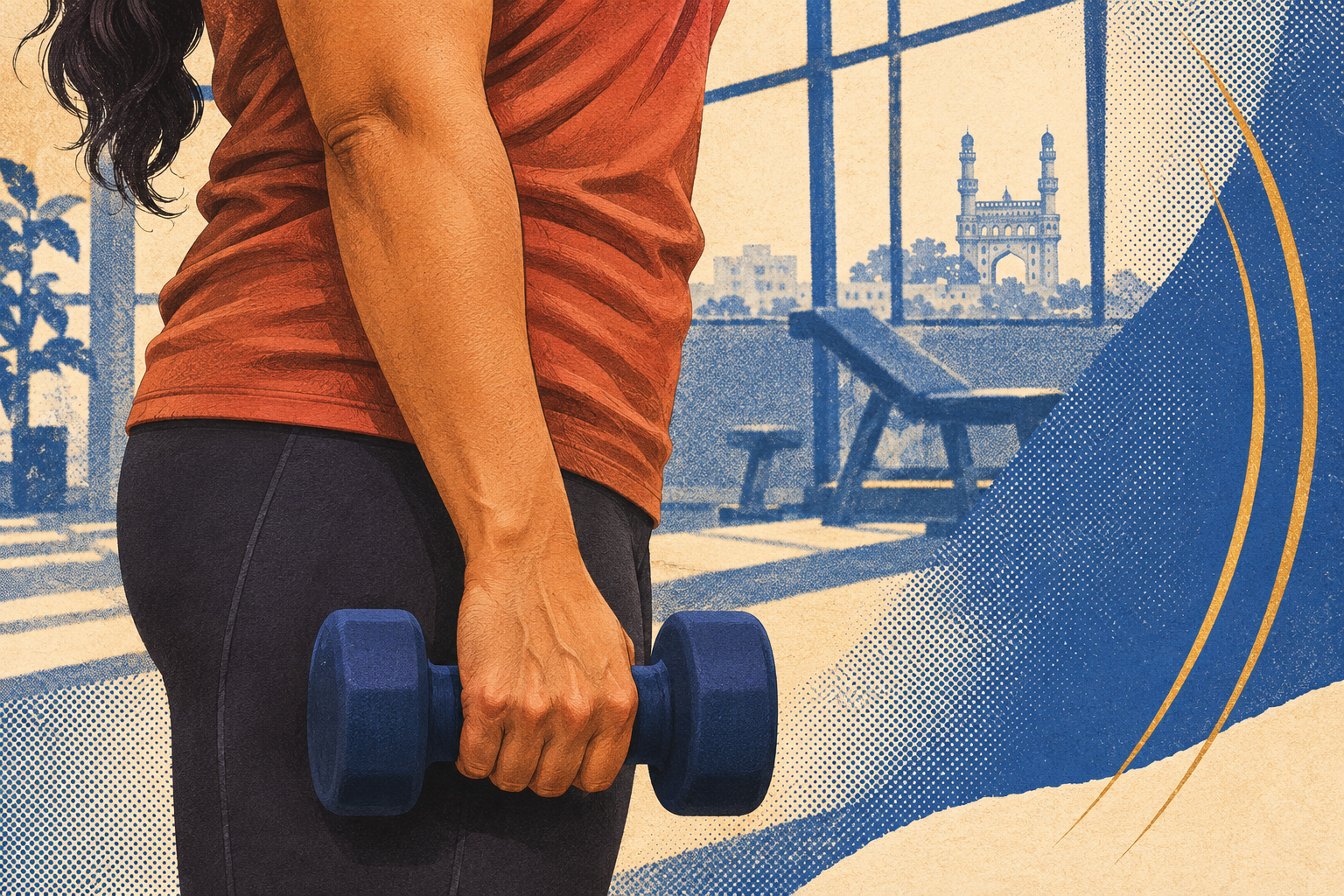
Imagine Asha in a Madhapur gym. Her first dumbbell curl comes up smoothly. On the way down it gets back to her thigh before she’s ready to start again.
A rep has an outward trip and a return
When Asha curls the dumbbell up, the muscles at the front of her upper arm shorten. As she lowers it, those muscles can stay active while lengthening. In a curl, that second part is the lowering phase, often called the eccentric phase.
If the weight drops through the last part of the return, that gives her something specific to practise. She can pay attention to the whole path back down, especially the bit she tends to hurry. On a different exercise, think about where the resistance is taking you. On a cable row, it is the cable drawing the handle away as your arms move forward.
Follow one dumbbell curl in both directions
- Lift
Curl the weight up
The muscles at the front of the upper arm shorten as the elbow bends.
- Lower
Guide the weight back
Those muscles can stay active as they lengthen and the elbow opens.
What a slower count actually tells you
A small eight-week study compared a fixed two seconds up and two seconds down with a pace chosen by the lifter. Twenty men without recent resistance-training experience used the fixed pace for one leg and a self-selected pace for the other on a knee-extension machine. The study found improvements in strength and a measure of muscle size, with no clear difference between the approaches.
In another eight-week knee-extension study with ten adults, four seconds of lowering favoured growth at one of three measured sites compared with two seconds. The difference in strength gains was small and uncertain. These were small studies of one exercise. They give little reason to chase one exact count for every lift.
Try one cue and see what changes
Say Asha has a manageable 4 kg dumbbell and eight reps on her plan. She notices the return speeding up on the second rep, while the lift itself still feels steady. On the next rep she can use a quiet “one, two” as a cue to guide the dumbbell down. The weight, rep target and cue are examples.
If the return is steady at a comfortable pace, she can drop the count. If she still has to swing up or hurry down, she can end the set and try a lighter option next time. A note such as “4 kg, return rushed by rep two” gives her something she can compare. She can keep the rest of the setup familiar so the comparison makes sense.
Keep the cue that matches what you saw
- Watch the return
The last bit drops
Use a brief count to notice where you hurry. Keep guiding the weight to the end.
- Change the load
Your body starts to swing
End the set. Try a lighter option or have someone check the setup.
- Drop the count
Both ways feel steady
Keep a comfortable rhythm. If you log the set, note the weight and whether you kept control.
Notice when slowing down is the result
A lift can slow as a set gets harder, even when you haven’t chosen a slower pace. That’s a different observation from a deliberately steady return. If the movement starts changing or you cannot guide the weight, end the set there. If the exercise causes pain, stop.
When Asha comes back to the rack, she can point to the bit she wants to practise. If she asks for help, “Could you watch the last part of the lowering?” is a question a trainer can act on.
Questions people ask
What does 3-1-1-0 mean on a squat plan?
In a common convention it means three seconds down, one second at the bottom, one second up and no planned pause at the top. Check how your plan defines the numbers. Some researchers and coaches describe the phases in a different order.
Evidence: [6]
Does this apply to a machine with a weight stack?
Yes, the same idea applies to guiding the return. On a suitable machine, ask a trainer where the movement begins and ends. A stack banging at the end of the return is a useful reason to check the setup and pace.
Evidence: [1]
Build your next step
Sources and further reading
- Mayo Clinic. Weight training technique, momentum and stopping for pain (January 2026, checked 10 November 2026)
- Chaves et al. Controlled versus self-selected repetition duration in untrained men (2020, checked 10 November 2026)
- Azevedo, Oliveira and Schoenfeld. Two- and four-second lowering phases in knee extensions (2022 issue, checked 10 November 2026)
- ACSM. Resistance training guidance for healthy adults (2026, checked 10 November 2026)
- IMFIT. Angadh demonstrations and shared-floor technique checks (checked 10 November 2026)
- Kojić et al. Phases and notation in a study of elbow flexor repetition tempo (2021, checked 10 November 2026)
Sources checked 2026-11-10.
This article is for general information and does not replace professional medical advice. Consult a qualified healthcare professional for guidance suited to your needs.
Ask for a check on the return
At IMFIT Madhapur, Angadh includes demonstrations and technique checks during individual practice on a shared floor. Ask a trainer to watch both parts of a familiar dumbbell rep and help you choose a cue you can repeat.
Explore Angadh coachingWas this useful?
A little feedback helps us choose what to explain next.
Your questions & thoughts
What would help you put this into practice?
Comments appear after review. Keep it kind and relevant; please leave out phone numbers, medical details and other private information.
Loading reader comments…
Leave a comment +