The playlist does not choose the weight
An imagined Madhapur gym moment: a favourite track starts in the earbuds just as a new lift is explained.
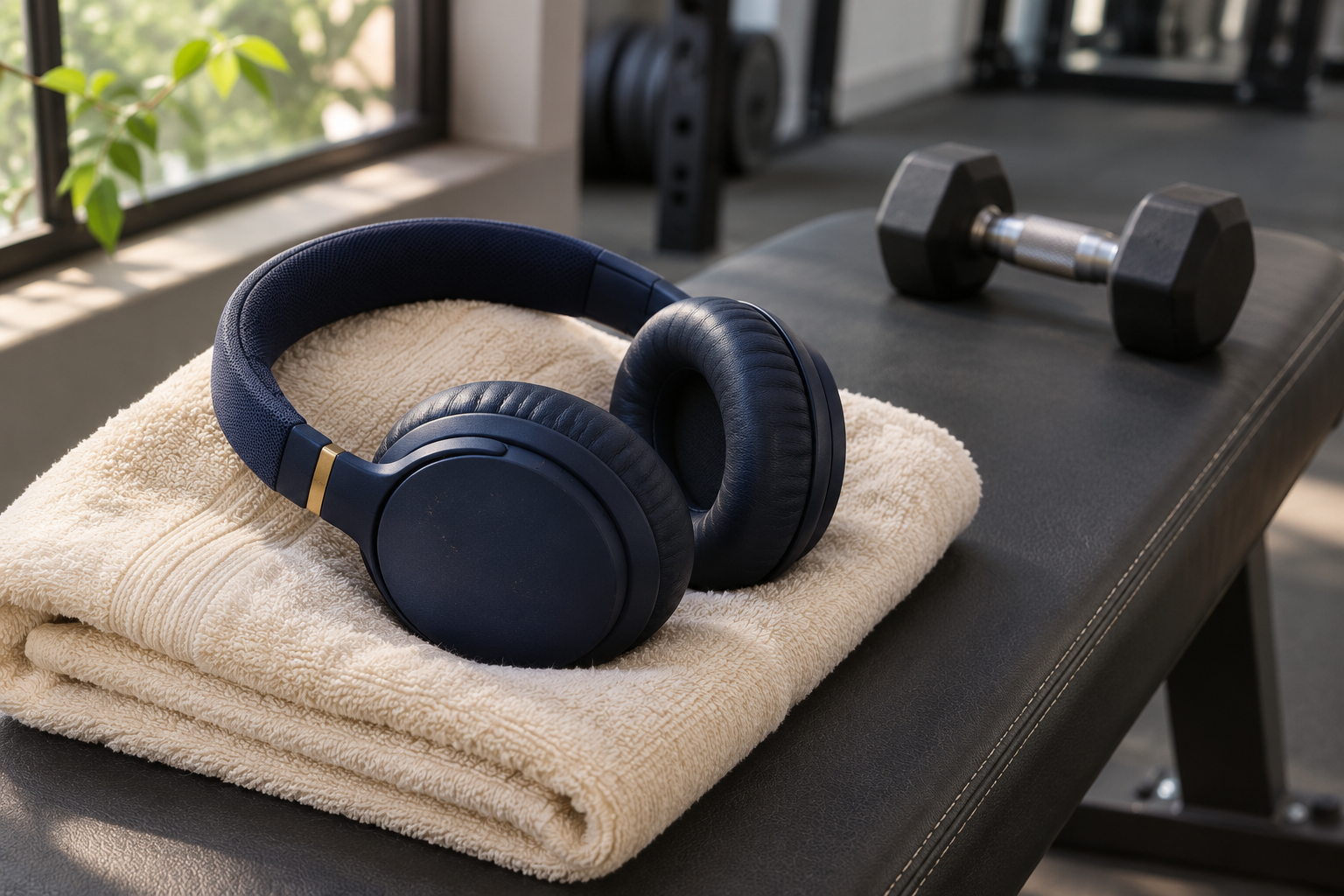
Music may make a session feel better, but performance findings are mixed and uncertain. Keep the planned weight and repetitions separate from feeling fired up. Pause the playlist when you need to hear an instruction.
A useful result needs the right comparison
A 2025 study tested 20 regional-level athletes in a fixed bench-press protocol under three conditions: self-selected music, stimulative music and no music. Average and peak power were higher with self-selected music than with no music. Self-rated activation was higher with self-selected music than with both other conditions.
Those are two different findings. Power concerns how quickly work is done. It is not the same as the heaviest weight someone can lift. Feeling activated is a reported state. The result does not mean that every fast song improves every lift, or that feeling more energised establishes a suitable heavier load. These athletes were not a sample of first-time gym users.
Evidence: [1]
Two results, different comparisons
- Own choice vs no music
Measured average and peak power
Higher with self-selected music than without music in this study.
- Own choice vs both alternatives
Self-rated activation
Higher with self-selected music than with stimulative music or no music.
Evidence: [1]
The wider evidence is less certain
A 2026 review brought together acute anaerobic-exercise findings from 21 studies. After accounting for different tasks, related results from the same studies and risk of bias, it found low-certainty favourable signals for repetition performance and feeling-scale scores. Effects on peak and average power, movement speed and several other outcomes remained uncertain.
The review includes the bench-press study discussed above; it is not a second independent test of those same athletes. Its cautious result is a reason to keep music in proportion: it can be a preference to use, not a guaranteed performance tool. These short-term findings do not establish that a playlist produces long-term muscle growth.
Change the audio, keep the agreed set
Back to our imagined beginner. He likes training with music, but today he is learning a movement. The useful choice is when to listen, not whether his playlist is impressive enough.
Before the demonstration starts, he can pause playback and put the earbuds away. Then he can listen to the explanation and say back the main cue he is meant to practise. If that cue is still unclear, the next step is another explanation, not pressing play and guessing. Agree when music can resume and how to ask for help.
For a familiar exercise, the song can change while the agreed work stays the same. Suppose his card calls for two sets at a familiar load: that is an illustrative plan, not a recommendation for everyone. A new track does not automatically add a third set or another plate. If he wants the work reviewed, he can discuss that separately rather than letting the chorus decide. Keep movement controlled and stop an exercise that causes pain.
Give the playlist a place in the session
- Choose deliberately
Before the session
Pick music you like if you want it; check the device’s listening-level features.
- Pause and listen
During an explanation
Pause playback, put earbuds away and say back the main practice cue before resuming.
- Keep the agreed plan
During familiar work
Music can resume when appropriate; the song does not change the planned load, reps or rests.
Louder is a different question
The research question about music and performance is separate from hearing safety. WHO says both sound level and exposure time matter. Turning a favourite track up to compete with a noisy room does not follow from a performance finding.
Use built-in sound-exposure monitoring or volume-limiting features where available, keep the level down and take breaks from loud sound in a quieter place. Listening time outside the gym counts too. If you have persistent ringing or difficulty hearing conversations, WHO advises contacting a professional. This article cannot assess your hearing or the sound level in a particular gym.
Evidence: [3]
Leave room for the coaching cue
At IMFIT Madhapur, Angadh includes individual free-weight and movement practice with shared trainer demonstrations and corrections. The trainer also attends to others; this is distinct from dedicated one-to-one PT. Agree how to get guidance and hear the explanation before continuing on your own. Ask about the gym’s listening arrangements rather than assuming that the same setup suits every session.
Our imagined beginner can choose a favourite track and also choose a clear pause for instruction. The useful next step is understanding the movement and the agreed work. Sunday is closed; an enquiry for a Monday–Saturday visit is a request, with arrangements confirmed by the team.
Questions people ask
Do I need headphones to train well?
No. Music is optional, and these studies do not make a personal device a training requirement. Follow the venue’s arrangements and choose a setup that lets you hear instructions when needed.
Should every repetition follow the beat?
Not automatically. A music-preference result does not prescribe a repetition tempo. Follow the movement instructions and stay controlled rather than speeding up to match a song.
Build your next step
Sources and further reading
- Bozzato et al.: self-selected music, bench-press power and activation (2025; original author abstract checked 16 November 2026)
- Qiu et al.: music during anaerobic exercise, task-dependent effects and low certainty (2026; full review checked 16 November 2026)
- WHO: safe listening, exposure monitoring, volume and warning signs (6 March 2026; checked 16 November 2026)
- Mayo Clinic: controlled weight-training technique and stopping painful exercise (checked 16 November 2026)
- IMFIT: current coaching formats; Angadh shared guidance also owner-confirmed 25 October (checked 16 November 2026)
- IMFIT: opening days and team-confirmed enquiries (checked 16 November 2026)
Sources checked 2026-11-16.
This article is for general information and does not replace professional medical advice. Consult a qualified healthcare professional for guidance suited to your needs.
Understand the set before pressing play
Ask for the movement and the main cue to be explained, then agree how to get help while practising.
Discuss coaching at IMFITWas this useful?
A little feedback helps us choose what to explain next.
Your questions & thoughts
What would help you put this into practice?
Comments appear after review. Keep it kind and relevant; please leave out phone numbers, medical details and other private information.
Loading reader comments…
Leave a comment +