Look for “per what?” first
To read protein on a food label, first find the quantity it refers to. Match that to the amount you will eat. A value per 100 g is not automatically the protein in your serving.
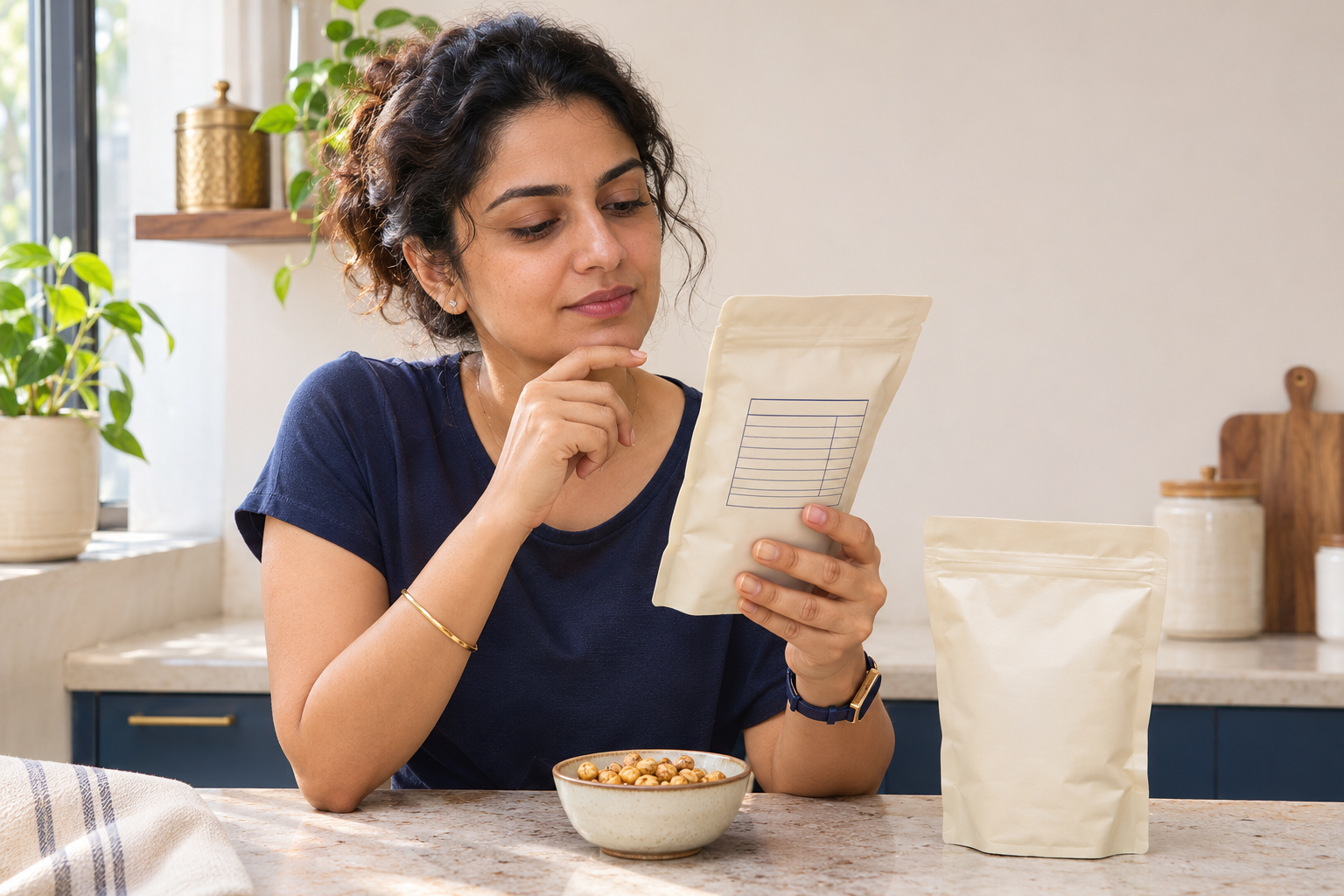
An imagined shopping decision: a gym beginner in Hyderabad compares two fictional snack labels. One says 20 g protein per 100 g; the other says 8 g per 30 g serving. Twenty looks bigger. The numbers are discussing different amounts of food.
The missing step: change the quantity
Use this calculation when the panel gives protein per 100 g: protein in your portion = protein per 100 g × portion weight ÷ 100. Keep the food weight and the protein weight separate. A 30 g portion means 30 g of food, not 30 g of protein.
Here is a fictional label for practice: 20 g protein per 100 g of a ready-to-eat snack. If you eat 30 g of that snack, the calculation is 20 × 30 ÷ 100 = 6 g protein. The 20 g figure has not disappeared; it describes a larger quantity than the one you ate.
These invented numbers do not describe a real product, a recommended portion or a protein target. They only practise reading a label.
Same food. Different quantities.
- 100 g food → 20 g protein
Label reference
The stated protein belongs to the full 100 g reference amount.
- 30 g food → 6 g protein
Amount actually eaten
20 × (30 ÷ 100) = 6. You ate three-tenths of the reference amount.
Now compare the two packets fairly
Return to the two fictional snacks. Call the first A: 20 g protein per 100 g. Call the second B: 8 g protein per 30 g. If the beginner plans to eat 30 g of either, A supplies a label-based estimate of 6 g and B supplies 8 g. Comparing 20 with 8 would have answered the wrong question.
For the same 30 g amount, B has more declared protein in this example. That does not make B the better overall purchase. Check the rest of the nutrition panel, ingredients and allergens, price, and whether the food suits your needs and preferences. A bigger protein number cannot settle all those questions.
If your planned amounts differ, calculate each actual portion instead. Equal weights help compare concentration; actual portions help estimate what you will eat. Neither comparison sets the amount you should eat.
A serving, a packet and a prepared bowl can differ
FSSAI’s consumer guide distinguishes serving size from the packet’s total net weight. Look for how many servings the pack contains. In our fictional A example, eating 60 g rather than 30 g would give 12 g declared protein, not 6 g. The other declared nutrients and energy also scale with the amount.
For a mix or powder, check whether the figures refer to the dry product or food prepared as directed. If a displayed total includes milk or another ingredient, do not count that ingredient again. Keep grams with a gram-based label and millilitres with a volume-based label; do not assume the two are interchangeable.
The label’s serving is a reference for interpreting its figures. It is not, by itself, an individual meal plan. If you need a personal protein target or have a prescribed diet, discuss that with a qualified dietitian or healthcare professional.
Use this on your next packet
- 100 g? Serving? Whole pack?
Find the reference
Write the protein figure and the food quantity it belongs to. Check dry versus prepared where relevant.
- 20 × 0.3 = 6 g
Match your amount
30 ÷ 100 = 0.3. In matching units: protein figure × your amount ÷ reference amount. If you eat exactly the stated serving, use its protein figure.
- Compare 6 g with 8 g
Make the comparison
Both refer to 30 g of food in our fictional A/B example. Compare the rest of the food and your needs before choosing.
Let the calculation answer one useful question
Protein helps build, maintain and repair muscle, but a nutritionally adequate diet matters alongside training. NIH’s exercise-nutrition guidance places supplements alongside, rather than in place of, that foundation. This calculation does not show how much muscle a snack will build or whether your whole day needs more protein.
Our imagined shopper can now compare the amount she would actually eat, then decide whether either packet earns a place beside her usual meals. There is no need to buy a food simply because its protein number is printed in a louder voice. For a broader food-pattern question, use the linked Indian-meals guide or seek individual nutrition advice.
Evidence: [4]
Bring the label and the question
If you are starting strength training at IMFIT Madhapur, bring a clear question rather than a product promise: “How does my current food routine fit the training I’m learning?” Angadh offers individual lifting and movement practice with shared-floor trainer demonstrations and corrections. Dedicated one-to-one personal training is a separate format.
Ask what support your chosen programme includes; individual nutrition needs may require a qualified dietitian. Sunday is closed, and an enquiry requests a conversation rather than confirming a visit.
Questions people ask
Does a 30 g scoop mean 30 g of protein?
No. It is the weight of the powder if that is what the label specifies. Use the protein amount declared for that serving, or calculate from the stated reference quantity. Check the serving weight; a scoop’s appearance is not a protein measurement.
Can this calculation prove that the label is accurate?
No. It estimates intake from the declared figures and your assumed amount. It cannot verify manufacturing accuracy, protein quality, absorption or a promised training outcome. A value per 100 g is a reference quantity, not evidence of deception by itself.
Build your next step
Sources and further reading
- FSSAI Eat Right India: how to read labels—serving size, net weight and nutrition basis (accessed 4 November 2026)
- FSSAI Labelling and Display compendium VIII, 9 September 2025, pp. 10–11: quantities and servings (accessed 4 November 2026)
- US FDA: serving size and portion arithmetic; educational principle, not Indian law (accessed 4 November 2026)
- NIH ODS: exercise and athletic performance—protein and dietary foundation (accessed 4 November 2026)
- IMFIT: current training formats and separate one-to-one PT (accessed 4 November 2026)
- IMFIT: opening hours and visit confirmation (accessed 4 November 2026)
Sources checked 2026-11-04.
This article is for general information and does not replace professional medical advice. Consult a qualified healthcare professional for guidance suited to your needs.
Put food questions beside your training plan
Tell the team what training you want to learn and ask what guidance each format includes. Bring the actual label if a food claim is confusing.
Compare coaching formatsWas this useful?
A little feedback helps us choose what to explain next.
Your questions & thoughts
What would help you put this into practice?
Comments appear after review. Keep it kind and relevant; please leave out phone numbers, medical details and other private information.
Loading reader comments…
Leave a comment +