Your list has booked a longer session than you have
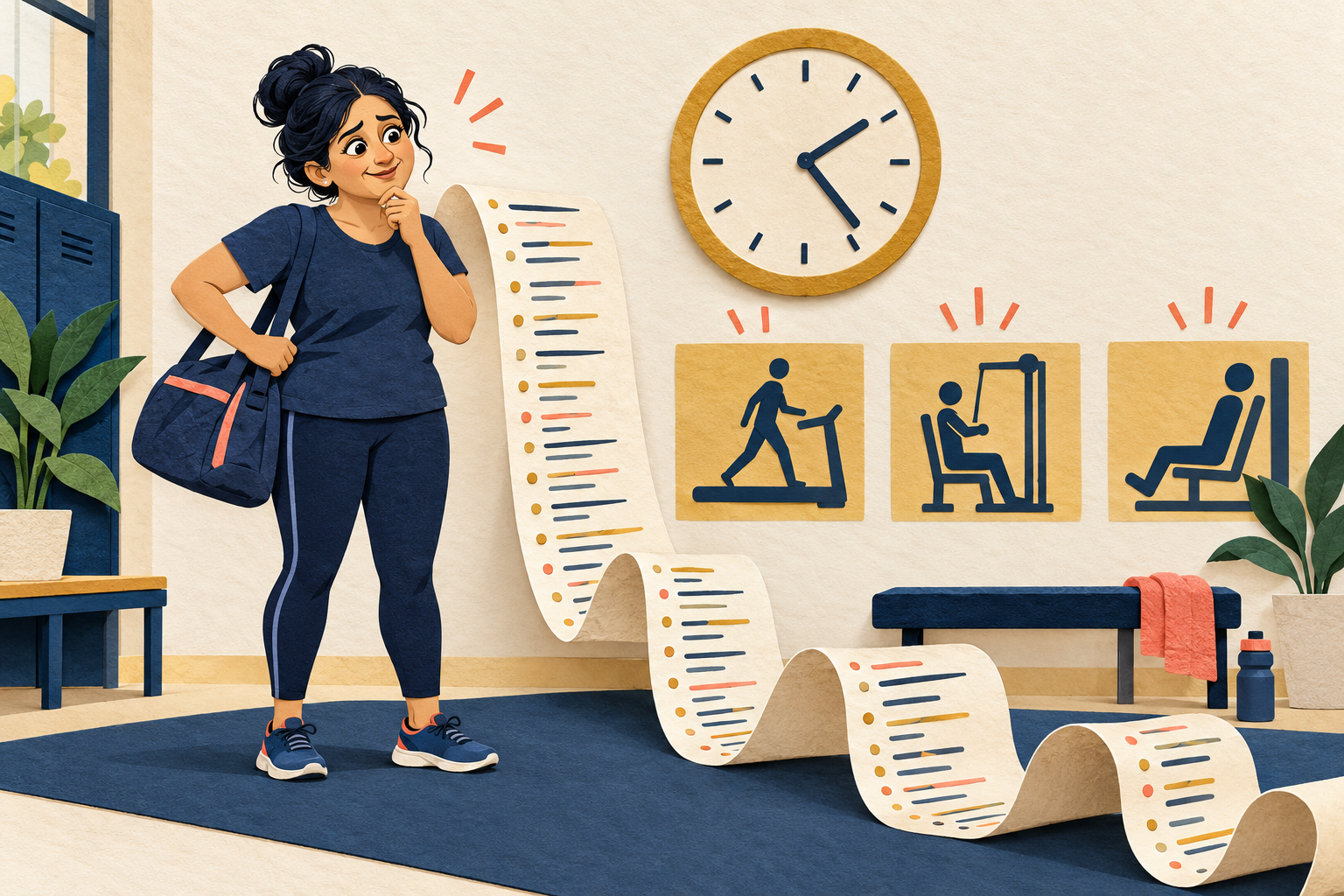
An imagined Monday: a Hyderabad beginner has thirty minutes and a saved workout with twelve exercises. The list has clearly booked a longer session than she has.
Yes, a 30-minute gym visit can support weight loss. Start with suitable preparation, three familiar strength movements and normal rests. Weight loss depends on an energy deficit over time—using more energy than you take in—not simply spending thirty minutes at the gym.
Give this visit three jobs
For a generally healthy adult who has already been shown suitable movements, this introductory example gives the visit three jobs: legs, push and pull. Choosing a few familiar exercises leaves room to check the setup and practise.
If the equipment or movement is new, use the visit for instruction instead of trying to finish the card. Three exercises are a starting example; a complete weekly strength plan needs wider muscle-group coverage. The exact combination and time budget below are editorial examples, not a tested fat-loss protocol.
Choose jobs before collecting exercises
3 jobs
Legs
Sit-to-stand: practise rising and sitting with control.
Push
Familiar chest press: learn the setup and controlled return.
Pull
Familiar seated row: use its own setup and suitable load.
Save this starting-session card
A repetition is one complete movement; a set is a group of repetitions. Follow the card from top to bottom, completing one exercise before moving to the next. For the machines, choose resistance you can control and have the seat, handles and safe return explained.
Rest about a minute between exercises, longer if needed. Keep breathing; reduce the load or repetitions when form becomes difficult. Stop for pain. These cues apply to all three movements—the rep number is not a reason to push through.
The card includes preparation and a gradual finish so they remain part of the visit. Its middle three steps share up to twenty minutes, including setup and rests.
Your starting-session workout card
- About 5 minutes
Prepare
Start with suitable easy aerobic movement, such as walking, and build gradually. Allow longer preparation when needed.
- 1 set · 5 reps
Sit-to-stand
Use a solid chair that cannot slip. Rise and sit slowly with control. Rest about a minute before the next exercise, longer if needed.
- 1 set · 12–15 reps
Seated row
Use a familiar machine and suitable load. Control the pull and return. Rest about a minute before the next exercise, longer if needed.
- 1 set · 12–15 reps
Seated chest press
Check your own seat and load. Keep the return controlled and breathe. Stop earlier if form breaks down or pain appears.
- About 5 minutes
Finish gradually
Ease down with suitable gentle movement. Note the work completed and any omissions. Finishing early does not require another round.
What happens during those twenty minutes?
The twenty-minute block is an allowance, not twenty minutes of lifting. For each movement: check the setup, rehearse as needed with guidance, complete the listed working set, then rest and move to the next station. A new beginner may spend more time adjusting the seat and understanding the return than doing repetitions.
For example, our imagined beginner finishes sit-to-stand and finds the row machine occupied. If it suits her agreed plan, she can do the familiar chest press first, then check the row again. If it is still busy, she records “row omitted” rather than learning a new cable exercise against a countdown.
If she finishes the work early, she can begin her gradual finish and leave early; she does not owe the clock extra rounds. If instruction or preparation takes longer, shorten the work. Allowing five minutes to prepare and five to ease down leaves up to twenty in a thirty-minute window; five minutes is the lower end of the cited warm-up/cool-down examples, not a readiness test.
Keep a short note: exercise, machine settings or load, reps completed and anything changed. An illustrative entry could read “chair: 5; press: 12; row: omitted—busy”. That describes a partial visit honestly and gives the next planning conversation something concrete.
At the next suitable visit, bring that note. A chest press logged as “12 controlled reps” can stay at the same manageable setting while she learns. When 15 controlled reps become comfortable and the load feels easy, she can ask her trainer about a small increase; if control breaks down, reduce the load or repetitions. Her “row omitted—busy” means revisit the row, not make the press heavier. Record what changes. There is no requirement to add weight every visit; the linked four-week guide helps build beyond this introductory session.
Will this actually help you lose weight?
It can contribute, but the exercise card alone does not establish an energy deficit. Food and drink affect energy coming in; physical activity adds to energy used. Strength training also develops strength and muscle. Sweating more or filling every minute does not prove that you have lost fat.
A practical weekly example is to keep feasible strength visits, include walking or other suitable aerobic activity, and review meals, snacks and drinks. If every gym visit ends with an extra drink and snack because you feel you have “earned it”, review that pattern rather than assuming the workout cancels it out. There is no fixed calorie allowance earned by this session.
General adult health guidance includes at least 150 minutes of moderate aerobic activity, or 75 vigorous minutes or an equivalent mix, plus strengthening on two or more days. Build from your starting point; cover the major muscle groups across the strength plan. The setup and rests here do not automatically count as thirty aerobic minutes. Weight-management needs vary.
For relevant conditions, injury or uncertainty about suitability, seek individual healthcare guidance. Stop if you feel unwell or develop concerning symptoms.
Bring the real time limit to IMFIT
Our imagined beginner’s useful next step is to bring the thirty-minute limit before choosing the workout. The long saved list can stay on the phone. A smaller understood session has a job she can explain.
At IMFIT Madhapur, Strength & Cardio combines machines, free weights and cardio with trainer guidance, with a muscle-building focus. The machine-based example here gives you a concrete starting question to discuss; it is not a fixed IMFIT thirty-minute session.
If you prefer free-weight lifting and movement practice, ask about Angadh. Members practise individually during open gym hours, with a shared trainer demonstrating and correcting before also attending to others. That is different from dedicated one-to-one personal training; it does not mean continuous supervision of every repetition. Exercises and loads should suit your starting point.
Ask: “I usually have thirty minutes. Which format and movements could fit, including preparation and rests?” The team confirms arrangements. An enquiry is a request, not a booking; Sunday is closed.
Questions people ask
Will this burn a particular number of calories?
No fixed calorie figure is promised. Energy use varies with the person, activity, intensity and actual time working. The rests and setup in this example are part of the visit; a watch estimate is not a measurement of fat lost.
Evidence: [1]
Do I need to add HIIT to make thirty minutes count?
No. This is a controlled introductory strength example, not an interval workout. More intensity is not automatically a better choice for your starting point. Arrange suitable aerobic activity across the week rather than adding unfamiliar hard intervals to beat the clock.
Can I use this example every day?
It is not a daily challenge. Avoid training the same muscles on consecutive days while using this beginner approach. Discuss a suitable week that covers the major muscle groups, recovery and other activity; the linked four-week guide gives a fuller starting example.
Build your next step
Sources and further reading
- CDC: physical activity, weight management and weekly activity guidance (7 April 2026)
- Mayo Clinic: introductory load, repetitions, controlled technique, rest and warm-up (21 January 2026)
- NHS: sit-to-stand, stable chair and introductory repetitions
- Mayo Clinic: gradual aerobic warm-up and cool-down examples (31 August 2023)
- ACSM: 2026 resistance-training update, individualisation and major muscle groups; official public summary
- IMFIT: membership and coaching formats; operational distinctions also confirmed by the owner on 25 October 2026
- IMFIT Angadh: individual coached functional training
- IMFIT: enquiry arrangements and Sunday closure
Sources checked 2026-10-28.
This article is for general information and does not replace professional medical advice. Consult a qualified healthcare professional for guidance suited to your needs.
Choose guidance for the way you train
Discuss your available time, starting experience and whether guided machine work, individual free-weight practice or dedicated personal training suits your needs.
Compare coaching formats